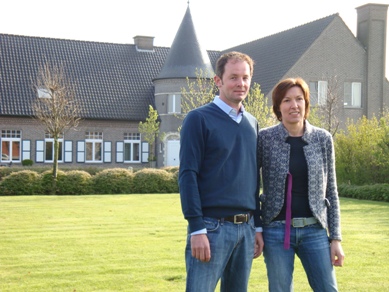
Kristof and Angelique Verschelde are a young couple working to carry on the family tradition of pork production in Nevele, Belgium. I had the opportunity to visit their farm and see their commitment to producing a quality product.
In 1968, Leon and Rose Verschelde, Kristof’s parents, started a farm with 35 sows and 25 dairy cows. From 1968 to 1995, the farm expanded to 375 sows and 80 dairy cows. Four years ago, Kristof took over part of the management of the farm from his parents, and by 2007, he had expanded to a 700-sow farrow-to-finish operation.
Sows are kept in five groups: 140 in the farrowing house, 140 in the breeding area, 140 in 4-week gestation, 140 in 8-week gestation and 140 in 12-week gestation. Weaned pigs are in two groups and market animals are in four groups. Replacement gilts start in the weaner barn and then go to a specific rearing house. After 30 weeks they go to the gestation room to be bred.
The work process is also divided into a 4-week system. Kristof says the advantages include:
- Fixed operation scheduling
- Work efficiency
- Only one age in the farrowing house at one time
- Two weeks of heavy work followed by two easier weeks
There are disadvantages too, with less opportunity to change planning and a weaker position in marketing.
The Verschelde’s have a closed herd to maintain a high health status. Most of the sows are an F-1 crossbred and 70 sows are grandparent stock. Pietrain genetics are used to produce market pigs while Large White and Danish Landtype breeding stock is used to produce females to retain in the herd.
A long lane with a scale close to the road allows for biosecurity. And two-site production breaks the disease cycle. As in North America, feed costs are significant, so the Verscheldes use liquid feeding. The farm has one full-time and one part-time employee in addition to Kristof and Angelique. Attention to detail allows them to achieve 14.67 live pigs born per sow per year, 2.48 litters per sow per year and 32.07 weaned pigs per sow per year. Those are numbers any North American producer would be proud of.
To achieve this level of production, the Verscheldes have prioritized these key management factors:
- Animal health
- Specific tasks in each stage of production
- Feed management optimization
- Cost control
- Attention to meat quality and taste
- Exchange of management and new technology ideas with other producers.
Challenges for pork producers in Europe are similar to those in North America, including cost control and pork prices. “Retailers lower the prices to the consumers by paying less on the level of the producer,” says Kristof. He says it’s frustrating to see that there is higher demand for pork from consumers, yet the prices are the same as they were 30 years ago. “Policymakers must realize that impermissible speculations on raw materials lead to, on the one hand the impossibility to conceive a good agricultural policy and, on the other hand, to more hunger.”
Guaranteeing the continuity and strength of the farming sector is important to European farmers, just as it is for North American producers.
Next week, we’ll talk about the marketing process in Belgium and some of the specialty products being produced.
Kristof and Angelique Verschelde are doing a good job in the Belgium pork industry.