Farms.com Home   Ag Industry News

Autonomous tractors on display at Farm Progress Show

CNH Industrial turning heads with its driverless tractor

By Diego Flammini
Assistant Editor, North American Content
Farms.com

Of all the equipment being showcased at the Farm Progress Show in Iowa, perhaps what’s turning the most heads is the introduction of autonomous tractors.

Some of the industry’s biggest manufacturers are unveiling what they feel is the next generation of tractors.

CNH Industrial and its technology provider, Autonomous Solutions Inc., debuted autonomous tractors – a cabless Case IH Magnum and a concept New Holland T8.

To control it, farmers input boundary maps into CNH’s system, which can help determine the most efficient routes. The system also automatically accounts for implement widths.

Farmers could operate one tractor or a number of tractors depending on need.
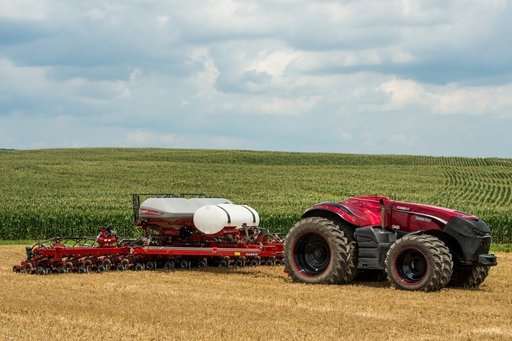
Case driverless tractor

“It could allow a person working with no employees to operate multiple tractors, or could complement very large operations that have challenged finding ample skilled workers,” Leo Bose, advanced farming systems marketing manager in a release.

The tractors can be equipped with a complete sensing and perception package, which includes radar and video cameras to ensure obstacles and other obstructions are avoided.

Farmers can have up to four real-time views of the tractor. A path-plotting screen shows the tractor’s progress, while another shows live camera feeds. Other screens allow producers to control engine speed, fuel levels, seeding rate and planter downforce.


Trending Video

Evolution of Beef Cattle Farming

Video: Evolution of Beef Cattle Farming

The Clear Conversations podcast took to the road for a special episode recorded in Nashville during CattleCon, bringing listeners straight into the heart of the cattle industry. Host Tracy Sellers welcomed rancher Steve Wooten of Beatty Canyon Ranch in Colorado for a wide-ranging discussion that blended family history and sustainability, particularly as it relates to the future of beef production.

Sustainability emerged as a central theme of the conversation, a word that Wooten acknowledges can mean very different things depending on who you ask. For him, sustainability starts with the soil. Healthy soil produces healthy grass, which supports efficient cattle capable of producing year after year with minimal external inputs. It’s an approach that equally considers vegetation, animal efficiency, and long-term profitability.

That philosophy aligned naturally with Wooten’s involvement in the U.S. Roundtable for Sustainable Beef, where he served as a representative for the Colorado Cattlemen’s Association. The roundtable brings together the entire beef supply chain—from producers to retailers—along with universities, NGOs, and allied industries. Its goal is not regulation, Wooten emphasized, but collaboration, shared learning, and continuous improvement.