The Innovation Center for U.S. Dairy surveyed 1,000 people in May
By Diego Flammini
Assistant Editor, North American Content
Farms.com
About 70 of the 1,000 people surveyed for Innovation Center for U.S. Dairy think chocolate milk comes from brown cows.
And almost half of the respondents were unsure where chocolate milk came from at all.
The survey didn’t ask where strawberry milk came from.
“Responses came from all 50 states, and the regional response breakdown was fairly even, with a slight uptick (approx. 10 percent higher) in the South,” Lisa McComb, spokeswoman for Innovation Center for U.S. Dairy, said in an email to the Huffington Post.
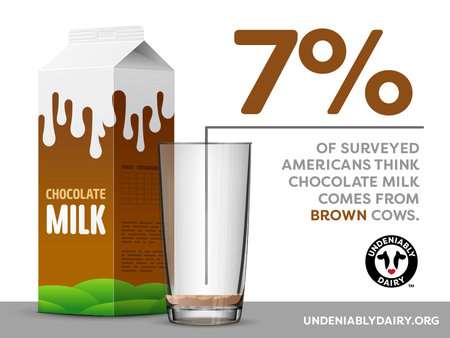
The results may seem laughable but they’re also a reminder of the need for consumer education.
“Consumers nowadays are five, maybe six, generations removed from agriculture,” Mitch Schulte, associate director with the Iowa State Dairy Association, told Farms.com. “I see this (survey result) as an opportunity to realize there’s more work for us to do. All of agriculture struggles to educate consumers and help build awareness of where their products are coming from.”
Here are other milk-related myths:
- Drinking chocolate milk causes weight gain, and
- The added sugars in chocolate milk will make children hyper.
Edelman Intelligence conducted the survey on the Innovation Center for U.S. Dairy’s behalf in May to kick off Innovation Center’s ‘Undeniably Dairy’ campaign.
Farms.com has reached out to Edelman Intelligence for complete survey results.