Farms.com Home   Ag Industry News

Farmers need to be thanked on Thanksgiving

Without producers, bountiful meals are impossible

By Diego Flammini
Assistant Editor, North American Content
Farms.com

Families throughout the United States will celebrate Thanksgiving this week, surrounded by friends, family and tables full of food.

And as people share what they’re thankful for, farmers should be at the top of the list. Because without farmers to produce the food that ends up on dinner tables, Thanksgiving would look very different.
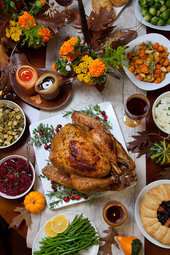
If someone wanted to scour the country for key Thanksgiving dinner ingredients, which states would they visit?

Turkey
It’s no surprise that turkey is the star of many Thanksgiving meals, and Minnesota is the top producer in the United States. According to the USDA’s Economic Research Service, Minnesota produced 41 million of the country’s 233 million turkeys in 2015 – that’s nearly 18 per cent!

Potatoes
If potatoes are part of Thanksgiving fare, look no further than Idaho. According to the USDA’s National Agricultural Statistics Service, farmers in the state are expected to produce 139.3 million cwt. of potatoes in 2016. Harvested acres are also forecasted to increase 2,000 over 2015 figures to 324,000 acres.

Cranberries
If cranberries make their way to dinner tables this Thanksgiving, there’s a good chance they came from Wisconsin. The University of Wisconsin-Madison says, since 1995, Wisconsin has produced about 57 per cent of the total cranberries in the U.S. The USDA estimates Wisconsin will produce more than five million barrels of cranberries in 2016 – one barrel weighs 100 pounds.

Carrots
If carrots end up on the plate, they may have come from California. According to the USDA’s Vegetables 2015 Summary, California harvested 63,000 acres of carrots in 2015 for a total of $638,631,000 in production.

Whatever ends up on plates for Thanksgiving meals, farmers need to be recognized for their roles in making those beautiful dinners possible.


Trending Video

How farmers are protecting the soil and our food security | DW Documentary

Video: How farmers are protecting the soil and our food security | DW Documentary

For a long time, soil was all but ignored. But for years, the valuable humus layer has been thinning. Farmers in Brandenburg are clearly feeling the effects of this on their sandy fields. Many are now taking steps to prepare their farms for the future.

Years of drought, record rainfall and failed harvests: we are becoming increasingly aware of how sensitively our environment reacts to extreme weather conditions. Farmers' livelihoods are at stake. So is the ability of consumers to afford food.

For a few years now, agriculture that focuses solely on maximum yields has been regarded with increasing skepticism. It is becoming more and more clear just how dependent we are on healthy soils.

Brandenburg is the federal state with the worst soil quality in Germany. The already thin, fertile humus layer has been shrinking for decades. Researchers and farmers who are keen to experiment are combating these developments and looking for solutions. Priority is being given to building up the humus layer, which consists of microorganisms and fungi, as well as springtails, small worms and centipedes.

For Lena and Philipp Adler, two young vegetable farmers, the tiny soil creatures are invaluable helpers. On their three-hectare organic farm, they rely on simple, mechanical weed control, fallow areas where the soil can recover, and diversity. Conventional farmer Mark Dümichen also does everything he can to protect soil life on his land. For years, he has not tilled the soil after the harvest and sows directly into the field. His yields have stabilized since he began to work this way.

Isabella Krause from Regionalwert AG Berlin-Brandenburg is convinced after the experiences of the last hot summers that new crops will thrive on Brandenburg's fields in the long term. She has founded a network of farmers who are promoting the cultivation of chickpeas with support from the scientific community.