Farms.com Home   News

Hog market highs: USDA report reveals soaring supplies

Hog market highs: USDA report reveals soaring supplies
Oct 03, 2017
By Kaitlynn Anderson
Assistant Editor, North American Content, Farms.com

Profit, affordable feed and new packing plants all contribute to expanding supply


By Kaitlynn Anderson

Staff Reporter

Farms.com


Hog supplies are plentiful in the U.S., according to the most recent USDA Quarterly Hogs and Pigs report.

As of September 1, there was an inventory of 73.5 million head for all hogs and pigs in the country. This number is an increase of 3 per cent from June 1 of this year, according to the report.
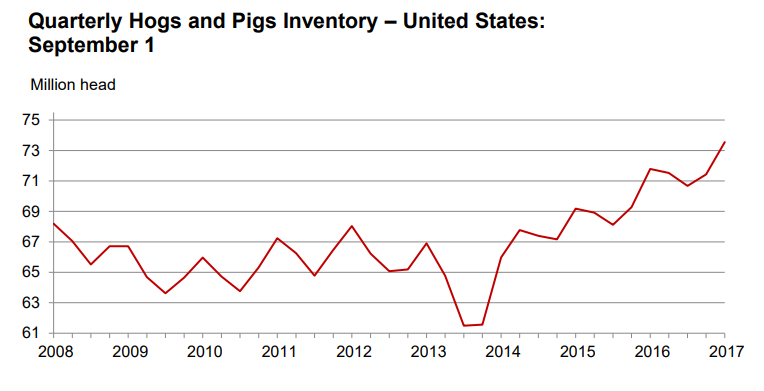
 

Source: USDA Quarterly Hogs and Pigs report, September 28, 2017


For the first three quarters of 2017 – March 1, June 1 and September 1 – hog and pig inventories have increased from 2016 levels, both for those kept for breeding and for those sent to market, according to the report.

Analysts believe that this high inventory is due to strong profit levels, more affordable feed and the use of several new pork packing plants, according to a Thursday article by Reuters.

Of the five new packing plants, four are already in operation.

While current supplies show growth in the sector, analysts warn that there will need to be a strong level of demand, both domestically and internationally, to accommodate these record numbers, according to the article.

Regardless of whether this demand is met, consumers could have access to lower pork prices throughout the beginning of 2018, according to the article.

Farms.com has reached out to AMS for comment. 


Trending Video

Evolution of Beef Cattle Farming

Video: Evolution of Beef Cattle Farming

The Clear Conversations podcast took to the road for a special episode recorded in Nashville during CattleCon, bringing listeners straight into the heart of the cattle industry. Host Tracy Sellers welcomed rancher Steve Wooten of Beatty Canyon Ranch in Colorado for a wide-ranging discussion that blended family history and sustainability, particularly as it relates to the future of beef production.

Sustainability emerged as a central theme of the conversation, a word that Wooten acknowledges can mean very different things depending on who you ask. For him, sustainability starts with the soil. Healthy soil produces healthy grass, which supports efficient cattle capable of producing year after year with minimal external inputs. It’s an approach that equally considers vegetation, animal efficiency, and long-term profitability.

That philosophy aligned naturally with Wooten’s involvement in the U.S. Roundtable for Sustainable Beef, where he served as a representative for the Colorado Cattlemen’s Association. The roundtable brings together the entire beef supply chain—from producers to retailers—along with universities, NGOs, and allied industries. Its goal is not regulation, Wooten emphasized, but collaboration, shared learning, and continuous improvement.