Farms.com Home   Ag Industry News

Indiana farm organizations assess presidential candidates

Soybean and corn organizations provide scorecard for presidential hopefuls

By Diego Flammini
Assistant Editor, North American Content
Farms.com

The Indiana Corn Growers Association (ICGA) and Indiana Soybean Alliance (ISA) released a scorecard of where the remaining presidential hopefuls stand on issues important to the two organizations.

The organizations looked at different issues including the farm bill, the Trans-Pacific Partnership, and voluntary GMO legislation and encourage farmers to make informed decisions when it comes to selecting the next American leader.
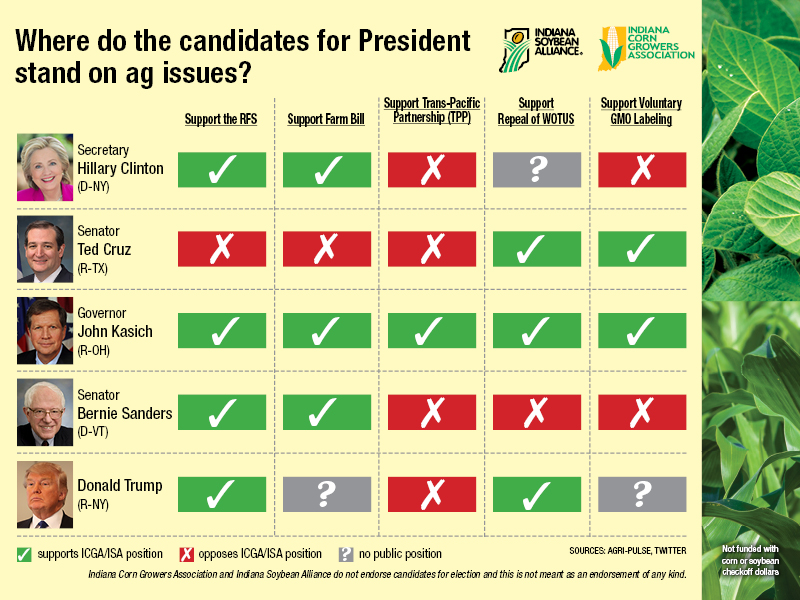
Presidential Scorecard

The release of the scorecard is timely as Indiana’s primary election day is Tuesday, May 3.

“It’s incredibly important for farmers to support a candidate who shares our beliefs on major ag issues,” said Mike Nichols, a farmer from Spencer County and president of the Indiana Corn Growers Association in a release. “We hope farmers do their homework on where all candidates stand on the ag issues important to them.”

Neither the ICGA or ISA have endorsed a candidate, but members are asking farmers to connect with the candidates and make them think about agriculture.

“If the candidates come to your area, engage them about agriculture,” said Jeanette Merritt, chair of the ISA’s Membership and Policy Committee in a release. “Ask a question at a town hall. It’s our job to keep agriculture on these candidates’ minds.”

After looking at the scorecard, are you surprised by the results? 


Trending Video

Evolution of Beef Cattle Farming

Video: Evolution of Beef Cattle Farming

The Clear Conversations podcast took to the road for a special episode recorded in Nashville during CattleCon, bringing listeners straight into the heart of the cattle industry. Host Tracy Sellers welcomed rancher Steve Wooten of Beatty Canyon Ranch in Colorado for a wide-ranging discussion that blended family history and sustainability, particularly as it relates to the future of beef production.

Sustainability emerged as a central theme of the conversation, a word that Wooten acknowledges can mean very different things depending on who you ask. For him, sustainability starts with the soil. Healthy soil produces healthy grass, which supports efficient cattle capable of producing year after year with minimal external inputs. It’s an approach that equally considers vegetation, animal efficiency, and long-term profitability.

That philosophy aligned naturally with Wooten’s involvement in the U.S. Roundtable for Sustainable Beef, where he served as a representative for the Colorado Cattlemen’s Association. The roundtable brings together the entire beef supply chain—from producers to retailers—along with universities, NGOs, and allied industries. Its goal is not regulation, Wooten emphasized, but collaboration, shared learning, and continuous improvement.