Farms.com Home   Ag Industry News

October 12 is National Farmer’s Day

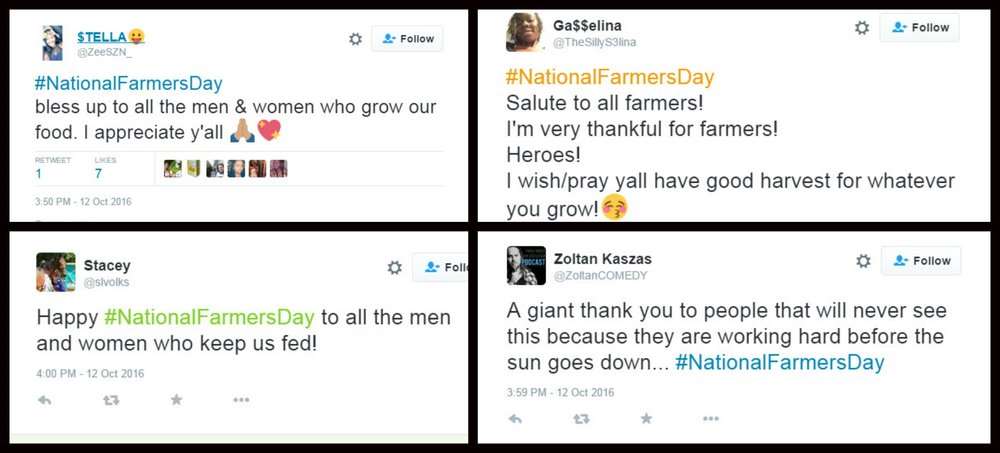
Social media buzzing with gratitude

By Diego Flammini
Assistant Editor, North American Content
Farms.com

October 12 is recognized as National Farmer’s Day, and people are taking time to thank farmers for their hard work in producing the food enjoyed around the world.
According to the 2011 Canadian Census of Agriculture:

  • There were 205,730 farms in Canada.
  • Most farm operators worked more than 40 hours per week.
  • Gross farm receipts accounted for C$51.1 billion in 2010.
  • With 19.4 million acres, canola replaced spring wheat as Canada’s number one field crop.
  • Between 2006 and 2011, the average size of a Canadian farm grew from 728 to 778 acres.

According to the 2012 American Census of Agriculture:

  • There were 2,109,303 farms in the United States.
  • The average size of a farm was 434 acres.
  • There was 914,527,657 acres of farmland.
  • Farms averaged US$187,097 in total sales.
  • The average market value of all machinery and equipment on farms was US$115,706.

Trending Video

Evolution of Beef Cattle Farming

Video: Evolution of Beef Cattle Farming

The Clear Conversations podcast took to the road for a special episode recorded in Nashville during CattleCon, bringing listeners straight into the heart of the cattle industry. Host Tracy Sellers welcomed rancher Steve Wooten of Beatty Canyon Ranch in Colorado for a wide-ranging discussion that blended family history and sustainability, particularly as it relates to the future of beef production.

Sustainability emerged as a central theme of the conversation, a word that Wooten acknowledges can mean very different things depending on who you ask. For him, sustainability starts with the soil. Healthy soil produces healthy grass, which supports efficient cattle capable of producing year after year with minimal external inputs. It’s an approach that equally considers vegetation, animal efficiency, and long-term profitability.

That philosophy aligned naturally with Wooten’s involvement in the U.S. Roundtable for Sustainable Beef, where he served as a representative for the Colorado Cattlemen’s Association. The roundtable brings together the entire beef supply chain—from producers to retailers—along with universities, NGOs, and allied industries. Its goal is not regulation, Wooten emphasized, but collaboration, shared learning, and continuous improvement.