Gunn’s Hill Wind Farm Project Generates Power
By Denise Faguy, Farms.com
The Oxford Community Energy Co-operative celebrated the inauguration of the Gunn’s Hill Wind Farm Project on Saturday, October 15th.
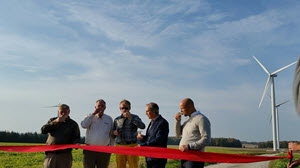
Gunn's Hill Ribbon Cutting Ceremony & Champagne Toast
While seeing 10 wind turbines with the rotors turning amongst the rolling hills on Ontario may no longer be unique in Ontario, the Gunn’s Hill wind farm is different because the Gunn’s Hill Windfarm is the first “Community” wind project in Canada. Oxford County is unique in that it has set a goal of sourcing 100% of its energy needs from renewable energy by 2050.
The project began in early 2014 as a Limited Partnership with the Six Nations in Grand River and Prowind. Less than 3 years later, the wind turbines are operational, and will be feeding power into the grid as of November.
“Behind us is our first turbine rotating and I feel good,” said Helmut, outgoing CEO, during the opening ceremonies. “There where many roadblocks to overcome, but we kept our promise: with every rotation of the blades you are reducing the burden on our environment and at the same time creating a profit from your investment.”
According to some expert calculations, approximately 400 households are supplied by each turbine, with each household having an average of 4 people. Since Oxford County has a population of 110,000, the 10 wind turbines at Gunn’s Hill represent between 10-15% of achieving Oxford county’s goal of 100% renewable energy?
For more information about the Oxford County Energy Co-operative: http://www.oxford-cec.ca/