Farms.com Home   Ag Industry News

Salford introduces high capacity-self-steering commodity cart with section control

Cart can carry up to 10 tons of two different products

By Diego Flammini
Assistant Editor, North American Content
Farms.com

Salford has introduced a new piece of machinery designed to help farmers spend less time in the field, but accomplishing more.

The PathFinder ST-10 self-steering commodity cart is capable of carrying up to 10 tons of two different products and controlling four different application sections.

It comes equipped with 120 and 180 cu ft. capacity tanks and uses Salford’s Valmar metering technology.
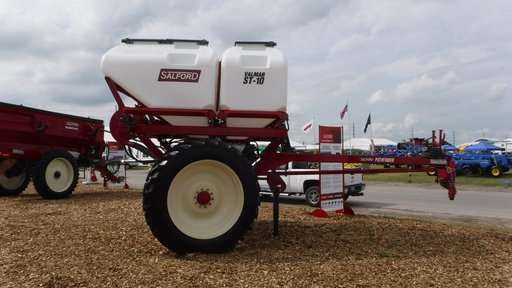
“Both metering systems deliver product to a single funnel that drops in to a common venturi air stream for the highest possible blending accuracy and efficienty,” Salford said on its website. “There is no need to run two sets of air lines to the application knife as all the blending happens right at the metering system.”

Dennis Rice, lead engineer at Valmar, said the metering system is designed to work with seed so it doesn’t crush fertilizer.

Jack Huerkamp, a farmer from Macon, Mississippi currently uses the PathFinder on his 1,800 acres of corn and cotton.

He said it made his days in the field a little bit easier.

“With the PathFinder we were able to speed up and increase our fertilizer output compared to our previous cart,” he said in a release. “We’d stop every now and again to get out a little chunk of fertilizer that might stop the rollers, but otherwise I could run our 12 rows with up to 600 pounds per acre at about 6 miles per hour.”


Trending Video

Evolution of Beef Cattle Farming

Video: Evolution of Beef Cattle Farming

The Clear Conversations podcast took to the road for a special episode recorded in Nashville during CattleCon, bringing listeners straight into the heart of the cattle industry. Host Tracy Sellers welcomed rancher Steve Wooten of Beatty Canyon Ranch in Colorado for a wide-ranging discussion that blended family history and sustainability, particularly as it relates to the future of beef production.

Sustainability emerged as a central theme of the conversation, a word that Wooten acknowledges can mean very different things depending on who you ask. For him, sustainability starts with the soil. Healthy soil produces healthy grass, which supports efficient cattle capable of producing year after year with minimal external inputs. It’s an approach that equally considers vegetation, animal efficiency, and long-term profitability.

That philosophy aligned naturally with Wooten’s involvement in the U.S. Roundtable for Sustainable Beef, where he served as a representative for the Colorado Cattlemen’s Association. The roundtable brings together the entire beef supply chain—from producers to retailers—along with universities, NGOs, and allied industries. Its goal is not regulation, Wooten emphasized, but collaboration, shared learning, and continuous improvement.