Farms.com Home   Ag Industry News

The Old Farmer’s Almanac releases U.S. spring forecast

The Old Farmer’s Almanac releases U.S. spring forecast
Feb 12, 2025
By Diego Flammini
Assistant Editor, North American Content, Farms.com

Expect temperatures to be warmer than normal

There are 36 days until March 20, the official first day of spring, and The Old Farmer’s Almanac released its forecast for Spring 2025.

“The U.S. spring outlook predicts warmer-than-normal temperatures for most of the country, with a few exceptions,” the forecast says.
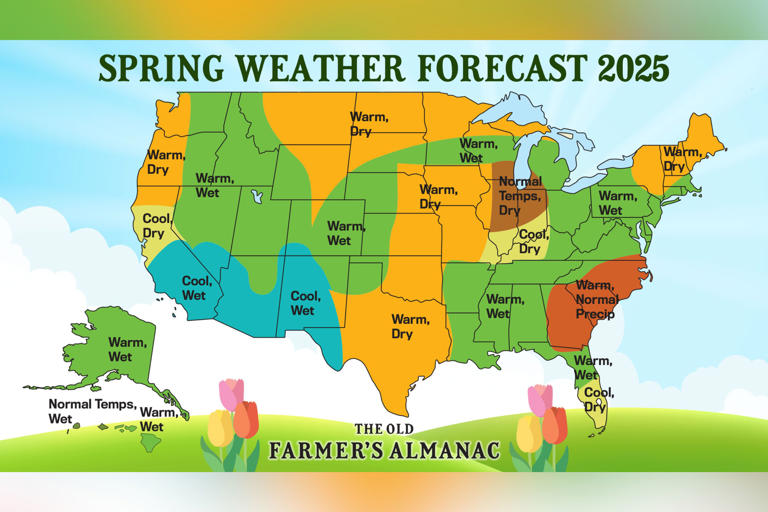
Spring 2025 forecast

Those exceptions are for places like New Mexico, Arizona, parts of California, and the western Ohio Valley. The almanac predicts cooler temperatures in April and May, and above normal levels of rainfall.

Here’s what the publication predicts for other areas of the country.

Farmers in the Upper Midwest, in the upper half of Wisconsin and Minnesota, can expect temperatures to be about three degrees above the average, with lower precipitation in the north, and wetter conditions in the south.

Growers in the Heartland, which includes Iowa, Missouri, and eastern Kansas and Nebraska, farmers could also see temperatures about three degrees above normal conditions.

“However, rainfall will be below normal across the region, with waves of heat and dry conditions likely to continue through the summer,” the almanac’s forecast says.

And producers across Michigan and the Great Lakes states can expect warmer temperatures, higher volumes of rainfall in the east, and lower amounts of precipitation in the west.


Trending Video

Independent Seed, National Impact | On The Brink: Episode 9

Video: Independent Seed, National Impact | On The Brink: Episode 9

A survey of 200 independent seed businesses reveals what Canada's seed sector actually contributes — and what it stands to lose.

On the Brink, Justin Funk, a third-generation agri-marketer, shares the findings of a national survey conducted in early 2026. The numbers reframe the conversation: independent seed companies in Canada represent upwards of $1.7 billion in dedicated seed infrastructure, approximately 3,000 full-time equivalent jobs in rural communities, and an estimated $20 million in annual community contributions. And roughly 90% of Canada's cereals, pulses, and other small pollinated crops flow through them.

The survey also asked how dependent these businesses are on public plant breeding to survive. The answer was unambiguous. For policymakers evaluating the future of publicly funded breeding programs, Funk argues the economic case for this sector and the case for public plant breeding are the same argument.

On the Brink is a cross-country video series exploring the future of plant breeding in Canada. Each episode features voices from across the industry in an open, ongoing conversation about innovation and long-term investment in Canadian agriculture.