Farms.com Home   Ag Industry News

Tornado destroys family farm in Saskatchewan

Simpson family overwhelmed by community support

By Diego Flammini
Assistant Editor, North American Content
Farms.com

A Saskatchewan family is beginning to rebuild after a tornado wiped out their farmhouse near Melville on Sunday.

“Our house was just thrown throughout the field here, and it was very surreal and emotional,” Jamie Simpson told CBC. “You can’t imagine this is ever going to happen to you.”

According to Environment Canada, the tornado touched down just after 4pm.

Simpson, her husband and two children sought shelter at her parents’ house, located on the same property. They all remained in the bathroom until the storm had passed.

“It picked up hay bales and moved them, like, half a mile,” Simpson told Global News. “All the cattle shelters are gone and corrals are torn up. You can see things that have gone through them.”
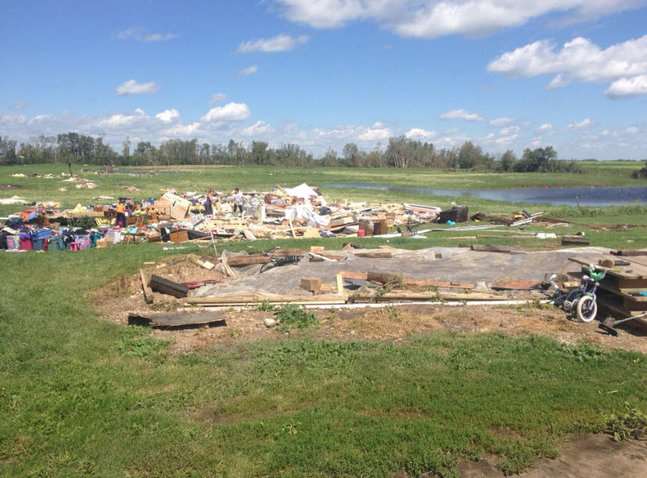
Saskatchewan tornado aftermath
The aftermath of a tornado that wiped out a farmhouse near Melville, Saskatchewan.
Photo: Blake Lough/Twitter

Simpson, whose family lived in the house since 2001, said everything they’ve worked for is gone. But they have to pick up the pieces and keep going forward.

The community is rallying behind the family to help them rebuild.

A Gofundme page launched on Monday to raise money for the family. To date, $12,205 has been raised. Far exceeding the goal of $5,000. Clothing and toy donations for her son and daughter are also needed.


Trending Video

What Does 20 MILLION Hogs a Year Look Like?

Video: What Does 20 MILLION Hogs a Year Look Like?


?? The Multi-Plant System Processing 20 Million Hogs Annually in the Midwest JBS USA operates multiple large-scale pork processing facilities across the Midwest, including major plants in Iowa, Minnesota, and Indiana. Combined, these facilities have the capacity to process approximately 20 million hogs annually.

Each plant operates high-speed automated slaughter systems capable of processing up to 20,000 head per day, followed by fabrication lines that break carcasses into primals, sub-primals, and case-ready retail products.

Hog procurement is coordinated through electronic marketing platforms that connect regional contract finishing operations and independent producers to plant demand schedules. This digital procurement system allows for steady supply flow and scheduling efficiency across multiple facilities.

Processing plants incorporate comprehensive food safety systems, including pathogen intervention technologies, rapid chilling processes, and integrated cold-chain management. USDA inspection is embedded throughout the harvest and fabrication stages to ensure regulatory compliance and product integrity. Finished pork products — from bulk primals to retail-ready packaged cuts — are distributed through coordinated logistics networks serving domestic and export markets.