Farms.com Home   News

A New Genomic Tool For Wheat Rust Researchers Worldwide

A new genomic tool has been launched to help the global community of wheat rust researchers.
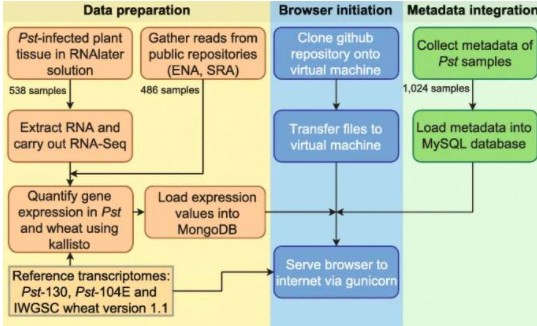
Flowchart
 

Flowchart illustrating the construction of the rust expression browser.

The Rust Expression Browser – developed by John Innes Centre researchers—is the first gene expression browser to enable simultaneous interrogation of gene expression data for the notorious yellow rust pathogen and its wheat host.

This new web interface currently hosts 1,024 gene expression datasets in an easy 'point-and-click' format to improve access to these valuable but complex data resources. In particular, it hosts hundreds of datasets generated by use of the revolutionary, genomic based 'field pathogenomics' technique that was developed in the Saunders Lab.

The yellow rust fungus causes devastating losses to wheat production worldwide and is a serious constraint on UK wheat production.

In a new paper published in BMC Genomics, researchers describe the creation of this new tool and demonstrate its utility for accelerating wheat yellow rust research.

Dr. Thomas Adams, the first author said: "We are thrilled to be able to share the wealth of data collected over the years by the lab with the wider community. We hope this will make these datasets more accessible to all researchers, regardless of access to specialist computer systems or any experience with sequencing data."

Click here to see more...

Trending Video

Seeing the Whole Season: How Continuous Crop Modeling Is Changing Breeding

Video: Seeing the Whole Season: How Continuous Crop Modeling Is Changing Breeding

Plant breeding has long been shaped by snapshots. A walk through a plot. A single set of notes. A yield check at the end of the season. But crops do not grow in moments. They change every day.

In this conversation, Gary Nijak of AerialPLOT explains how continuous crop modeling is changing the way breeders see, measure, and select plants by capturing growth, stress, and recovery across the entire season, not just at isolated points in time.

Nijak breaks down why point-in-time observations can miss critical performance signals, how repeated, season-long data collection removes the human bottleneck in breeding, and what becomes possible when every plot is treated as a living data set. He also explores how continuous modeling allows breeding programs to move beyond vague descriptors and toward measurable, repeatable insights that connect directly to on-farm outcomes.

This conversation explores:

• What continuous crop modeling is and how it works

• Why traditional field observations fall short over a full growing season

• How scale and repeated measurement change breeding decisions

• What “digital twins” of plots mean for selection and performance

• Why data, not hardware, is driving the next shift in breeding innovation As data-driven breeding moves from research into real-world programs, this discussion offers a clear look at how seeing the whole season is reshaping value for breeders, seed companies, and farmers, and why this may be only the beginning.