By Ethan Carter
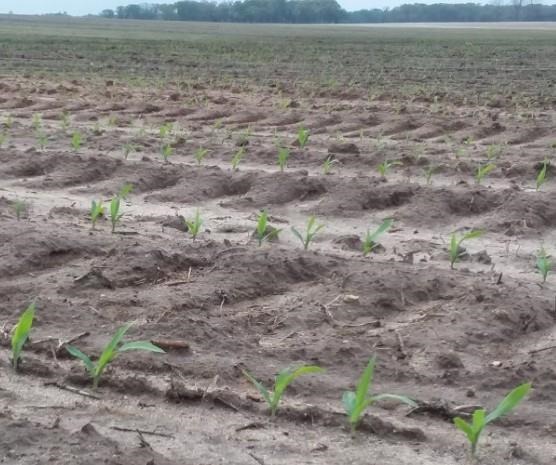
Emerging corn. Credit: Ethan Carter, UF/IFAS
One of the first row crops to be planted each year is corn. Florida plantings typically range from late February through April, varying by grower and production system. Three consecutive days with morning soil temperature of 55° at a two-inch depth is preferential for optimum germination. Currently many growers are reflecting on the previous crop’s field performance, trying to decide which varieties they want to use this coming season. Others have already decided and are in the process of sourcing and ordering seed.–
Ryan Jenkins inspects corn from his variety trial in Santa Rosa County.
Although variety selection is important, rainfall and irrigation play an equally large role in a farmer’s yield expectations. It is necessary for a farmer to select varieties that have performed well under conditions similar to those on their own farm. Dryland grain corn production is highly variable. In a dry (typical) year total crop failure can occur, while in a wet year grain yields of well over 100 bu/ac are possible. Irrigated grain corn fields have more consistent yield potential, because the crop is not as weather dependent. These fields can consistently yield over 200 bu/ac when other factors (fertility, pests, etc.) are well managed.
Weed free corn field.
There are several online resources available to help with variety selection. The largest data set with growing conditions similar to those of North Florida is provided by the University of Georgia, specifically coastal plain locations such as Tifton (dry and irrigated). The UGA data included both grain and silage corn varieties. Available Florida specific data includes local grain yield checks performed on-farm in Jackson County, as well as silage corn data from the UF/IFAS research station in Citra, Florida.
The University of Florida has a field corn production guide that can be used to answer many general production questions. You may also want to read through the recently updated 2022 UGA Corn Production Guide.
Source : ufl.edu