By Matt Lollar
Peas are a staple food throughout the South. Whether you prefer southern peas, cowpeas, or blackeye peas, they are all under threat from the cowpea curculio, also known locally as pea weevils. With the mild winter this year, growers can anticipate that cowpea curculios may show up much earlier in the season, with a much higher population than in years’ past.
Cowpea Curculio Biology
In order to more effectively control cowpea curculios, a better understanding of their biology is important. Cowpea curculios are small (slightly longer than an 1/8 inch), shiny, dark weevils. Their life cycle from egg to adult ranges from 30 to 40 days. The adults feed on pea pods and lay eggs either in the pod or in the individual peas. The eggs hatch inside the pod and the grubs (larvae) feed from within the pod. When the grubs are ready to pupate, the eat their way out of the pod through tiny holes. They then fall to the ground and burrow 1 to 3 inches into the soil where they pupate and emerge as adults and the cycle begins again. If peas are harvested while larvae are still in the pods, the larvae are considered a contaminant causing quality loss in addition to yield loss.
Cowpea curculio adult.
Cowpea Curculio Management
An Integrated Pest Management (IPM) plan is needed in order to minimize cowpea curculio infestations. IPM relies on a combination of strategies to effectively suppress pest populations. The management of cowpea curculios requires a multi-pronged approach that includes scouting and monitoring, alternative host control, and insecticides.
Cowpea curculio damage.
- Scouting and Monitoring:Pea crops should be scouted weekly or more frequently. It is important that you scout both before and after insecticide applications to document product effectiveness. Curculios are first seen at field edges and are found in greater numbers on lower portions of individual plants. Shaking plants over a white beat cloth allows for easier counting. Yellow pyramid traps can be placed at field edges for early pest detection.
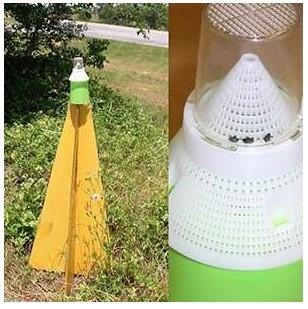
Cowpea curculio trap
- Alternative Host Control:Crop rotation and field location are important because cowpea curculios can feed on early-planted snap beans and other beans. Weed control in and around the field is critical because curculios can reproduce on sicklepod during the summer and can overwinter on other leguminous weeds throughout the fall and winter. Fall tillage and field sanitation can help slow down population buildup.
- Insecticides:Insecticides should be applied religiously from first flower to the pre-harvest interval. The most effective insecticides are all in the pyrethroid mode of action group (Group 3). However, cowpea curculios have become resistant to most products. Baythroid (beta-cyfluthrin) and Besiege (lambda-cyhalothrin + chlorantraniliprole) offer good control, but it is important that they are rotated with other modes of action. More cowpea curculio control information can be found in the “Vegetable Production Handbook for Florida – Legume Production” chapter.
Table adapted from the “Vegetable Production Handbook for Florida – Legume Production” chapter.