By Dr. Alison Robertson and Jyotsna Acharya
As more producers integrate cover crops into their operation, there has been increased interest in planting corn into a green or living cover crop, such as cereal rye, and terminating the cover crop after planting.
To help provide some insight into how “planting green” might affect corn growth and yield, we did an experimental field plot study comparing the effect of termination date of a winter cereal rye cover crop on growth, development, seedling disease and yield of corn in 2019 and 2020. This research project is being funded by USDA-NIFA through the Critical Agricultural Research and Extension program. Below is a summary of what we learned.
We looked at terminating the cereal rye cover crop 18 and 3 days before (DBP), and 6 and 12 days after planting (DAP) corn (Fig. 1.) Cereal rye biomass in 2020 was almost double that of 2019. In both years, corn seedlings were taller and shoot dry weight was less in the treatments where cereal rye was terminated after planting the corn (Table 1). In 2020, the corn seedlings in the treatments where cereal rye was terminated after planting the corn were approximately half a growth stage behind the no cover crop control and the treatments where cereal rye was terminated before planting. Radicle rot was more severe in the treatments where cereal rye was terminated after planting the corn compared to the remaining treatments. Yield was lowest when cereal rye was terminated 12 DAP corn.
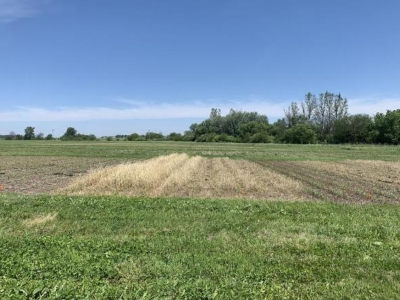
Fig. 1. Photo of field plots to investigate the effect of planting corn into a green cereal rye cover crop near Boone, Iowa.
Table 1. Effect of termination treatments of a winter rye cover crop on corn seedling growth, root disease at growth stage V2 to V3, barren plants at R6, and yield in Iowa.
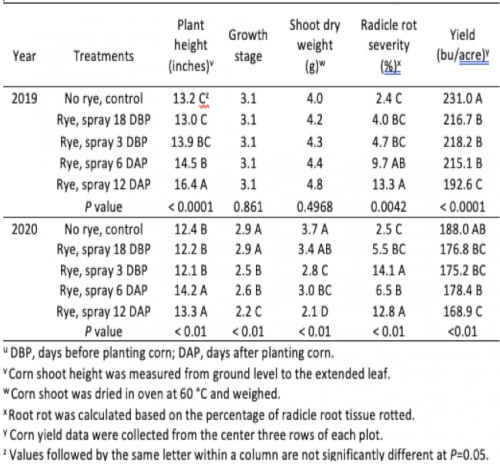
These data suggest that planting corn into a green cereal rye cover crop may contribute to seedling disease, and negatively affect corn growth, development and yield. To mitigate risk, we continue to recommend terminating a cereal rye cover crop 10 to 14 days before planting corn.
We are continuing to investigate the effect of planting green on corn. As part of this project, we are working with Practical Farmers of Iowa to collect on-farm data on planting green. In addition, Iowa is one of 15 states investigating the effect of planting green on weeds, insects, diseases, and corn development and yield from 2021 to 2023 as part of a USDA-NIFA CAP project being led by Steven Mirsky at USDA-ARS BARC, Maryland and Chris Reberg-Horton from North Carolina State University.
Source : iastate.edu