By Jim Harvey
It has been a difficult year so far between the COVID-19 issues and the challenging weather. In times like these, it is easy to get overwhelmed and forget the basics of the required regulations.
Following the WPS basics should keep you out of trouble with your Department of Agriculture inspector while also minimizing your pesticide-related liability.
Pennsylvania growers who need the updated materials consistent with the 2015 WPS revision can get them free of charge from Jim Harvey at the Pennsylvania Office of Rural Health (PORH) at Penn State University. You can contact Jim at 814-863-8656 or via email at jdh18@psu.edu. We can supply a variety of WPS materials needed as part of your WPS compliance efforts. Due to the COVID-19 travel restrictions, we are unable to provide orchard visits right now but available to answer your questions by phone or email and mail your materials.
If you want to stay current with WPS news (there really isn’t that much!), ‘like’ us on Facebook at “Worker Protection Standard-PORH or contact Jim to be placed on our new WPS email listserv.
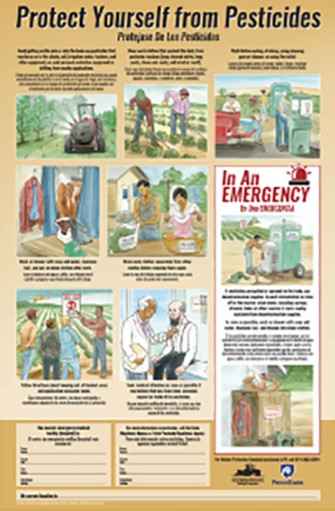
There are still growers who are not up to date with their WPS posters. If your WPS poster is over 4 years old it is outdated. There are now several acceptable WPS posters but the free Penn State poster looks like this:
Alongside your WPS poster and pesticide records, you need to have copies of your Safety Data Sheets (SDS). The old MSDS (Material Safety Data Sheets) are not acceptable anymore so make sure you have the newer SDS. We cannot supply you with your SDS materials, but you can download the SDS from the internet or request them from your pesticide supplier.
You must train your employees once a year. After the training, make sure that they sign off on the training and keep the sign-off sheets for at least two years. You must use the updated training material consistent with the 2015 WPS revision. Contact Jim if you need training materials because the training videos are available online or on DVDs, and now flash drives.
At this point the EPA has not relaxed label required personal protective equipment (PPE) requirements. You are still required to use all the label required PPE. If you do not have enough PPE to get through the season you might want to look at alternate pesticides that require PPE that you have available.
The AEZ (Application Exclusion Zone) proposed changes have not yet been finalized so at this point you are still required to follow the original AEZ rules that came out in the 2015 WPS revision. No one except properly equipped and trained handlers can be within 100 feet of an air blast sprayer. That AEZ can still extend out into the road or onto your neighbor’s property as you apply in border areas.
The Respirator Fit Test process must be completed each year if you are using pesticides requiring a respirator. First, check your medical release to be sure that it is still good. Then complete the fit test and finally the respirator training. As long as you are using pesticides that require a respirator the fit test and training must be done each year.
In this year of so many uncertainties, there are few things that you can control as easily as your WPS compliance. Don’t forget it!
Source : psu.edu