Farms.com Home   Farm Equipment News

Exploring Updates to John Deere Self-Propelled Forage Harvesters

John Deere rolled out the 9000 Series Self-Propelled Forage Harvesters (SPFH) about three years ago. Now, the company is looking to expand upon this series in order to cater to operators who want more assistance harvesting high-quality forage. For model year 2022, Deere will be adding the 9500 model to its lineup of self-propelled forage harvesters. In addition, the 9500 and 9600 models will have an 18.0L John Deere 18X engine for more power.
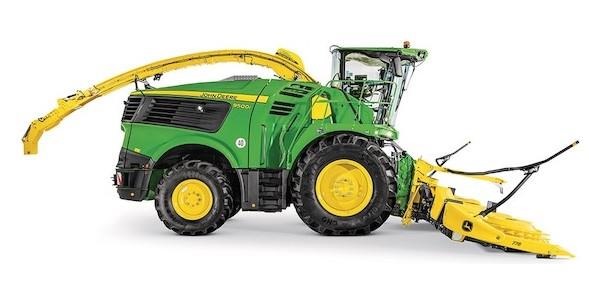
Forage Harvesters

“Customers want rugged, high-capacity forage harvesters that provide constant maximum throughput with fewer blockages and downtime for service and maintenance, along with the ability to monitor, adjust and document processing of the forage for optimal feed value,” said Chase Milem, John Deere marketing manager for forage harvesters. “From top to bottom, 9000 Series Self-Propelled Forage Harvesters deliver on those needs with comfort and performance.”

With new features, the 9000 Series Self-Propelled Forage Harvesters will help producers improve crop flow and ultimately boost efficiency.

What is a Self-Propelled Forage Harvester?

A self-propelled forage harvester is typically used to make food for livestock. Forage that is created with these machines can deliver a better feed value, which puts the animals in a better position to produce. John Deere’s self-propelled forage harvesters make serviceability a breeze while improving crop flow.

John Deere 9000 Series SPFH Updates

Numerous updates have been made to the 9000 Series Self-Propelled Forage Harvesters. The new 9500 specifically has a rated power of 690 horsepower, as well as a HarvestMotion™ Plus rating of 755 horsepower, which is generated by its inline six-cylinder 18.0L John Deere 18X engine.

Introducing the New John Deere 9500 Combine

The model year 2022 9500 was also designed with improving crop flow in mind. Operators now have more visibility and control during the unloading process. With HarvestMotion Plus, engine speed, crop flow, and power are all synchronized to maintain consistent crop throughput at low RPMs. There is also less fuel consumption, and no diesel exhaust fluid required.

Enjoy Maximum Power with the John Deere 18X Engine

The 18.0L John Deere 18X engine provides unmatched performance. It is a diesel engine, meaning operators don’t have to concern themselves with diesel exhaust fluid. This engine also meets Final Tier 4/Stage V emission regulations, giving operators peace of mind. HarvestMotion Plus allows it to achieve unique power and torque rise in the 700- to 800-PS power class for the utmost efficiency. It also has a long engine oil service interval, peaking at 750 hours, meaning less downtime for operators.

Click here to see more...

Trending Video

Turning Plant Defense Into a Management Strategy

Video: Turning Plant Defense Into a Management Strategy

Turning Plant Defense Into a Management Strategy

Understanding how a plant responds to stress is one thing.

Using that knowledge to make better management decisions is another.

Systemic acquired resistance, or SAR, is the plant's more direct defense response. When stress or infection occurs, the plant begins signaling throughout its system and preparing defensive compounds.

But if we know that response exists, can we help prepare the plant before the stress arrives?

The answer starts with understanding what triggers the response and what the plant needs to carry it out.

The Trigger and the Fuel

Salicylic acid plays an important role in triggering the SAR pathway.

Think of it as turning the truck on.

The engine may be running, but it still needs fuel to do the work.

In this case, manganese plays an important role in supporting the enzyme systems involved in the plant's defensive response.

This makes manganese status an important part of the conversation. Whether a producer is using tissue testing, sap analysis, or simply scouting for visible deficiency symptoms, the goal is to make sure the plant has adequate manganese available.

Manganese is required in relatively small amounts, but that does not make its role small.

If the plant receives a signal to defend itself but lacks the nutrition needed to support that response, it may struggle to carry out the process efficiently.

The trigger matters.

The fuel matters too.

Prepare Before the Stress Arrives

The best time to think about stress management is before the plant is overwhelmed.

Once a crop is already struggling, management can quickly turn into a game of catch-up.

This is similar to nitrogen management. Once a plant becomes severely deficient, correcting the problem does not necessarily erase the time and yield potential already lost.

Plant defense can work the same way.

Low-rate, targeted approaches designed to support the SAR pathway may fit best ahead of an expected stress event rather than after significant damage has already occurred.

That requires producers to think about predictable stress.

We may not know exactly what the weather will do tomorrow, but we generally know summer heat is coming. We know certain field conditions increase disease pressure. We know a herbicide application can temporarily stress a crop as the plant processes the chemistry.

Even a properly timed and labeled herbicide application can create a temporary response in the plant.

That does not mean the herbicide is bad.

Weeds can create significantly more yield loss than the temporary stress caused by controlling them.

The question is not whether we should eliminate every stressor.

The question is whether we can better prepare the plant to manage necessary and predictable stress.

Not All Stress Is Bad

Stress is a normal part of plant growth.

A perfectly stress-free environment does not exist in the field.

In fact, some stress is necessary for normal plant development. A plant responds to wind, temperature, moisture, sunlight, and countless other environmental signals throughout the season.

The environment is stress.

The plant's job is to manage it.

Problems begin when the stress load becomes greater than the plant's ability to respond.

Extreme heat, drought, high salt concentrations, disease pressure, and even certain management practices can add to that load.

This is where understanding SAR becomes useful.

Instead of waiting until the plant is visibly struggling, producers can begin identifying periods when stress is likely and make management decisions around those windows.

ISR Starts With the Soil

While SAR is a more direct defense response, induced systemic resistance, or ISR, brings the conversation back to soil health.

The longevity of a farm is closely connected to the health of its soil.

Carbon plays a major role because it supports biological life within the soil. Bacteria, fungi, and other organisms interact with plant roots and influence how the plant grows, accesses nutrients, and prepares for stress.

This is why soil health cannot be reduced to one product or one application.

It is a system.

Keeping living plants in the field longer can support biological activity. Cover crops may fit some operations. Better water management can improve soil conditions.