From snow throwers to manure spreaders – the company continues to innovate after more than 50 years
After celebrating 50 years of service and production in 2010, Husky Farm Equipment is still going strong. The company, which was founded in 1960 by Raymond Grose, has humble beginnings, and an impressive past.
Raymond Grose was born in 1932 and was raised on a farm in Alma, Ontario. He marked the fourth generation of his family that farmed in the Alma area. As an adult, he purchased a farm next to his father’s farm and married a woman named Ruth Wood. Raymond was proficient with mechanical tasks, and Ruth was skilled at accounting and book keeping – both skills that would greatly help with the future business endeavors of the couple. Raymond purchased a welder in 1955 for $250, when he only had $100 to pay down at the time.
5 years later in 1960, a snow thrower was designed in order to go behind a Ferguson tractor, but Raymond and Ruth had no intentions of marketing or selling the machine. However, a neighbor spotted it one day and offered to purchase the machine. The snow thrower was sold for $250, and marked the beginning of the business. The success of their first snow thrower encouraged Raymond to produce 10 more throwers that year, followed by 20 produced the year after, and then over 50 machines produced the year following that. The quick increase in business and sales meant that Raymond and Ruth required extra help with their business, as well as improvements to the working space. When the company began, Raymond was producing the snow throwers in a horse stall of his barn. He built a double garage to use as a manufacturing facility for his products. In total, 360 of the snow throwers were made and sold under the “Raymond” name.
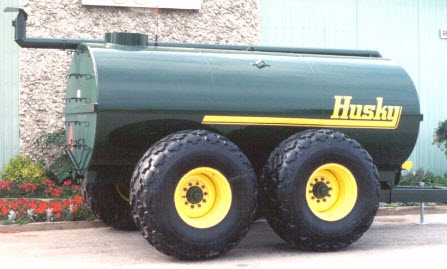 The quick success of the snow throwers pushed Raymond and Ruth to expand into other forms of equipment, as well as providing repairs to products. In 1963, Raymond was invited to a meeting where Badger brought their first liquid manure pump and spreader into the United States. He immediately saw the potential in handling manure in liquid form, and began to expand the business even more, including the production of liquid manure equipment. Since the business was growing, an accountant advised them that the company be incorporated. In 1966, “Grose Welding Limited” was formed and two years after that a new shop was built nearby the old farm buildings. Raymond felt that the company might struggle to grow under his own name, so he made the decision to change the name of the company to “Husky Farm Equipment Limited”, which he felt indicated strength and power.
Though there were some challenges with starting up their company – mainly issues with standardizing the machines, creating parts books and part numbers, and providing services – the company remained strong and continued to make improvements to their brand. Another improvement to the company was made with the hiring of Don Grant, a draftsman. In January of 1998, the company was transferred to Walter and Gordon Grose, who have continued to maintain the company’s high standards in offering quality equipment and quick service.
As well as selling used equipment, Husky Farm Equipment produces a variety of farming necessities, such as: manure spreaders, manure pumps, drag hose equipment, truck mounts and various parts for their products.
For more information about Husky Farm Equipment, please visit www.huskyfarm.ca.