By Anna King
Mason Douglass dials his desk phone from a spick-n-span triple-wide plunked in a gravel lot in front of 30 silver corrugated silos outside of Connell, Washington.
“It’s probably going to be a voicemail,” he murmurs.
Douglass is the general manager of Tri-State Seed on the north edge of Connell.
“Hey Matt, this is Mason with Tri-State Seed returning your phone call,” he chirps after the beep.
Douglass gets about 10 calls from all over the West a day, farmers looking to plant forage crops for cattle – oats, barley and triticale.
“So, I got your message,” Douglass says. “You’re looking for some oats and some haybet barley. I hate to let you know, but unfortunately we’re out of oats and barley at this time. I don’t even know where to send you … I think everyone in this local area is sold out.”
He says those few seeds that are available are double the price they should be.
In fact, this year Tri-State Seed is hedging a bit by making additional contracts with farmers on irrigated ground to grow seeds.
“We put a lot more stuff on irrigated, which costs more money to go do” Douglass says. “But we’re trying to produce more to hopefully have more to sell to our customers this fall. Mother Nature is I guess the unpredictable beast that we face.”
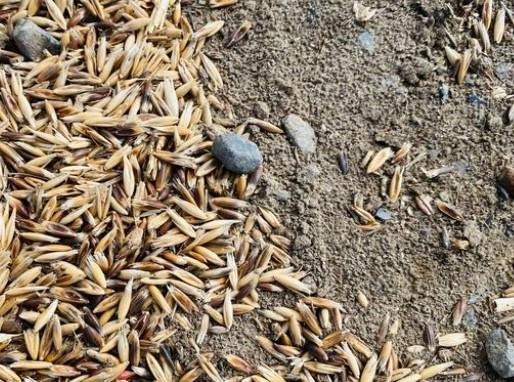
A few piles of spilt oats litter the ground outside of Tri-State Seed outside of Connell, Wash. Most oat, barley and triticale seed has been sold out across the West. Whatever seed is left is selling at very high prices.
Not since 1895
Jeff Marti is the drought coordinator for Washington state’s Department of Ecology.
“So last year was a really bad year for drought,” Marti says. “Really extraordinarily dry year. One of the driest years since 1895.”
He says it's not looking good this spring east of the Cascades in Washington or across much of Oregon.
And the region is still recovering from last summer's unprecedented triple-digit heat dome event. Marti says the state is watching declining conditions closely and may extend its drought declaration this June. The snowpack across the Northwest has entered the "melt phase," he says.
“This winter we needed to have just a really good comeback year,” Marti says. “We needed an awesome snowpack, lots of precipitation, especially on the east side. And that didn’t happen.”
Click here to see more...