By Kapil Arora and Daniel Andersen
U.S. Department of Agriculture Secretary Tom Vilsack recently announced a $1.2 million award to fund a high-clearance robotic irrigation system that will eventually be used in Iowa. The project, which aligns nutrient application timing to a crop’s nutrient needs to improve efficiency and reduce nutrient loss, is a collaborative of Iowa State University, the 360 Yield Center and The Ohio State University.
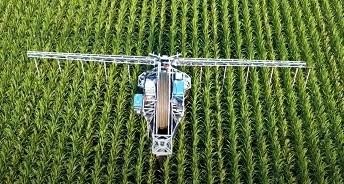
Engineers with Iowa State University Extension and Outreach are directly involved with the project.
The initiative is one of 19 projects funded by the USDA under the Conservation Innovation Grants program. CIG is a competitive program that supports the development of new tools, approaches, practices and technologies to further natural resource conservation on private lands. These projects focus on helping agricultural producers mitigate the effects of climate change and increase the resilience of their operations.
“Innovation is key to addressing the climate crisis and conserving the natural resources we all depend on,” said Terry Cosby, chief of the Natural Resources Conservation Service. “CIG partners are using the latest science and research to come up with solutions that work for farmers, ranchers and foresters and help ensure the longevity of American agriculture.”
Agricultural engineering specialists with ISU Extension and Outreach will lead Iowa State’s research efforts. The team includes Daniel Andersen, Kapil Arora, and Matthew Helmers, as well as Kelvin Leibold, farm management specialist with ISU Extension and Outreach.
“This collaborative project between Iowa State University, Ohio State University and 360 Yield Center intends to demonstrate an innovative unified strategy of in-season application of commercial or animal nutrients along with water application to reduce nutrient losses while improving profitability with increased grain yields,” said Arora.
Andersen said, “This project on high-clearance robotic irrigation converges to find profitable solutions for the needs of present-day Iowa agriculture while protecting the environment.”
Source : iastate.edu