By Dorivar Ruiz Diaz and Chris Weber
Wheat is considered a highly responsive crop to band-applied fertilizers, particularly phosphorus (P). Application of P as starter fertilizer can be an effective method for part or all the P needs. Wheat plants typically show a significant increase in fall tillers (Figure 1) and better root development with the use of starter fertilizer (P and N). Winterkill can also be reduced with the use of starter fertilizers, particularly in low P testing soils.
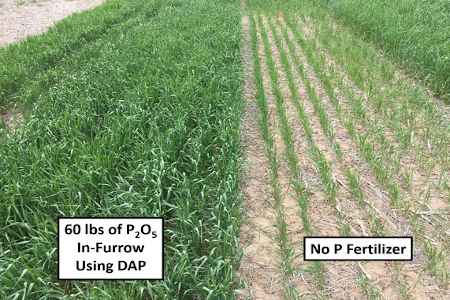
Figure 1. Effects on wheat tillering and early growth with in-furrow P fertilizer on soil testing low in P. Photo taken in 2020 in Manhattan, KS.
In-furrow fertilizer application
Phosphorus fertilizer application can be done through the drill with the seed. In-furrow fertilizer can be applied, depending on the soil test and recommended application rate, either in addition to or instead of, any pre-plant P applications. The use of dry fertilizer sources with air seeders is a very popular and practical option. However, other P sources (including liquid) are agronomically equivalent and decisions should be based on cost and adaptability for each operation.
When applying fertilizer with the seed, rates should be limited to avoid potential toxicity to the seedling. When placing fertilizer in direct contact with wheat seed, producers should use the guidelines in Table 1.
Table 1. Suggested maximum rates of fertilizer to apply directly with the wheat seed
Pounds N + K2O (No urea containing fertilizers)
|
Row spacing
(inches) | Medium-to-fine
soil textures | Course textures or dry soils
|
15 | 16 | 11 |
10 | 24 | 17 |
6-8 | 30 | 21 |
Air seeders that place the starter fertilizer and seed in a 1- to 2-inch band, rather than a narrow seed slot, provide some margin of safety because the concentration of the fertilizer and seed is lower in these diffuse bands. In this scenario, adding a little extra N fertilizer to the starter is less likely to injure the seed - but it is still a risk.
What about blending dry 18-46-0 (DAP) or 11-52-0 (MAP) directly with the seed in the hopper? Will the N in these products hurt the seed?
The N in these fertilizer products is in the ammonium-N form (NH4+), not the urea-N form, and is much less likely to injure the wheat seed, even though it is in direct seed contact. As for rates, guidelines provided in the table above should be used. If DAP or MAP is mixed with the seed, the mixture can safely be left in the seed hopper overnight without injuring the seed or gumming up the works. However, it is important to keep the wheat mixed with MAP or DAP in a lower relative humidity. A humidity greater than 70% will result in the fertilizer taking up moisture and will cause gumming or caking within the mixture.
How long can you allow this mixture of seed and fertilizer to set together without seeing any negative effects to crop establishment and yield?
The effects of leaving DAP fertilizer left mixed with wheat seed for various amounts of time is shown in Figure 2. Little to no negative effect was observed (up to 12 days in the K-State study) as long as the mixture is stored at a relative humidity less than 70%.
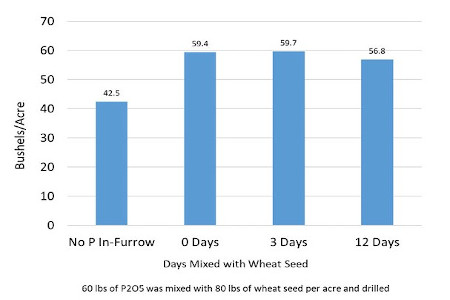
Figure 2. Effects on wheat yield from mixing P fertilizer with the seed. Study conducted in 2019 and 2020 at sites in Manhattan, Rossville, and Topeka.
Although the wheat response to these in-furrow fertilizer products is primarily from the P, the small amount of N that is present in DAP, MAP, or 10-34-0 may also be important in some cases. If no pre-plant N was applied, and the soil has little or no carryover N from the previous crop, the N from these fertilizer products could benefit the wheat.
Source : ksu.edu