From Iowa State University News
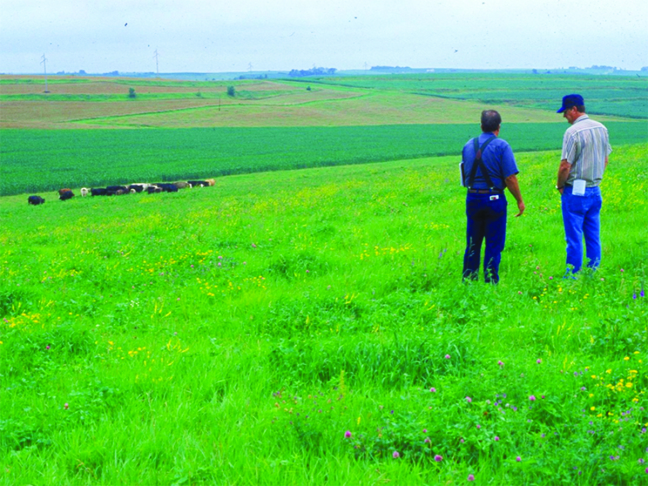
Cattle graze on pasture land on an Iowa farm.
Cattle graze on pasture land on an Iowa farm.
A new study co-authored by an Iowa State University researcher indicates that an increase in cattle production, and associated forage land, on Iowa’s agricultural landscape could lead to lower greenhouse gas emissions.
The research, published recently in the peer-reviewed Journal of Soil and Water Conservation, found that cattle production yields a smaller percentage of greenhouse gas emissions than row-crop cultivation.
That suggests integrating more cattle production into Iowa’s agricultural portfolio may cut the state’s greenhouse gas emissions and lead to other environmental benefits, said Mark Rasmussen, director of Iowa State’s Leopold Center for Sustainable Agriculture and co-author of the study.
But those benefits largely would depend on new forage land on which the cattle would feed, Rasmussen said. More forage and pasture land means more roots in the ground holding soil in place and increasing the land’s capacity to store carbon, he said.
“The paper shows that bringing more cattle back to Iowa and, as a consequence, adding more land for forage and perennial grasses, would actually be beneficial in the context of greenhouse gas emissions that result from agricultural activities,” he said. “It’s a way of putting more carbon away than you’re putting into the atmosphere.”
Cattle produce the greenhouse gas methane through their ruminant digestive process. But those emissions make up a smaller percentage of anthropogenic, or man-made, emissions than row-crop production, Rasmussen said. The study found that ruminants generate 11.6 percent of total anthropogenic emissions, while cropping and soil-associated emissions contribute 13.7 percent.
On the other hand, converting acres currently devoted to crops into forage land would cut down on carbon emissions that result from organic matter released by soil erosion, Rasmussen said. More forage or perennial grasses would improve the environment in other ways as well.
Less runoff from fields would protect water quality, and more grazing land would create new habitat for pollinating insects, he said. And adding forages such as alfalfa in longer crop rotations can actually build organic matter in the soil over the course of a few years.
“Soil degradation is a long, gradual process so it’s easy to ignore sometimes,” Rasmussen said. “Soil has been ignored for a long time, but this might be a way of rehabilitating vulnerable land.”
Rasmussen acknowledged that serious challenges stand in the way of integrating more cattle into Iowa’s agricultural infrastructure. Converting land from row crops to grazing land for cattle would require a significant investment in new facilities and equipment, he said. And grass-fed cattle take more time to get to market than grain-fed cattle and require different genetics.
He also cautioned that the best results depend on cattle production that practices responsible use of forage land. Overgrazing a section of land can actually result in more erosion, Rasmussen said.
Source:iastate.edu