By Ashley Dean and Erin Hodgson
The cool spring has delayed development of many important crop pests across Iowa. However, with recent warm temperatures, Japanese beetle adult emergence has been on track with previous years. Japanese beetle adults begin emergence when approximately 1,030 growing degree days (GDD; base 50°F) have accumulated since January 1 and will continue emerging until 2,150 GDD have accumulated. Japanese beetle adults likely began emerging in the southern portion of the state last week, and emergence will likely occur within the next two weeks in northern Iowa (Figure 1).
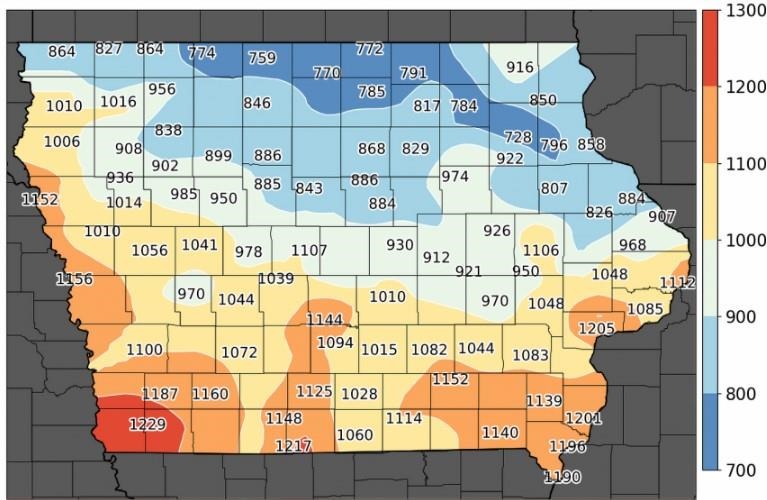
Figure 1. Growing degree days accumulated (base 50°F) in Iowa (as of June 20, 2022). Adults begin emerging around 1,030 degree days. Map courtesy of Iowa Environmental Mesonet, Iowa State University Department of Agronomy.
Japanese beetles have a wide host range that includes many species of fruit and vegetable crops, ornamentals, and field crops. Feeding will look a bit different depending on the host plant, but since beetles have chewing mouthparts, they consume plant tissue and cause defoliation. In field crops, adults tend to be denser at the field edge. Additionally, a combination of sex pheromones, aggregation pheromones, and feeding-induced plant volatiles lead to clusters of Japanese beetle adults feeding in one spot. Since feeding can look severe near the edge of fields, it is important to scout the entire field to get a representative estimate of injury.
On soybean, adults prefer to feed between the leaf veins and can ultimately consume most of the leaf, leaving a skeletonized appearance (Photo 1). If adults are still present in the field, the treatment threshold for Japanese beetle in soybean is 30% defoliation before flowering (R1) and 20% after R1. It is important to note that defoliation can be caused by several pest species with chewing mouthparts. Estimations of defoliation should be made for the entire field and plant canopy. Humans tend to overestimate defoliation; use the Crop Protection Network’s Insect Defoliation Tool to train your “defoliation eye.”
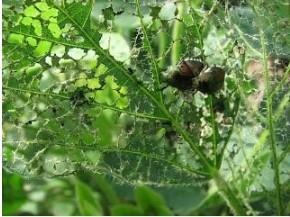
Photo 1. Japanese beetle adults defoliate soybean and skeletonize leaves, meaning they leave behind the leaf veins.
Japanese beetles do not typically feed on corn leaves, but adults have a long emergence period and remain active throughout the summer. Once corn reaches VT or R1, consider scouting for Japanese beetle. Adults can feed on both the tassels and silks. Silk clipping can interfere with pollination (Photo 2). Consider a foliar insecticide during tasseling and silking if three criteria are met: there are 3 or more beetles per ear, silks have been clipped to less than ½ inch, AND pollination is less than 50% complete.
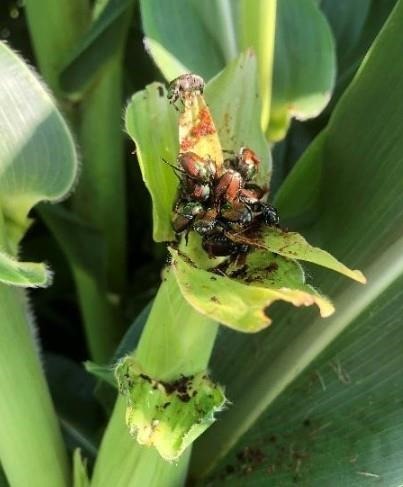
Photo 2. Japanese beetle adults aggregating and feeding on corn silks near the field edge.
Source : iastate.edu