By Paul D. Esker and Alyssa Collins
As barley moves through heading, we are now also turning our attention to wheat. Fields are moving along and could begin to flower in some areas this week. The current risk of Fusarium head blight (FHB), caused by the fungal pathogen Fusarium graminearum, has lowered over the past several days. As of May 18, the risk of FHB is low across Pennsylvania and the extended forecast is indicating that risk will remain at this level (Figure 1). Additionally, we have not seen much for other foliar disease development except for differing levels of powdery mildew depending on the wheat variety.
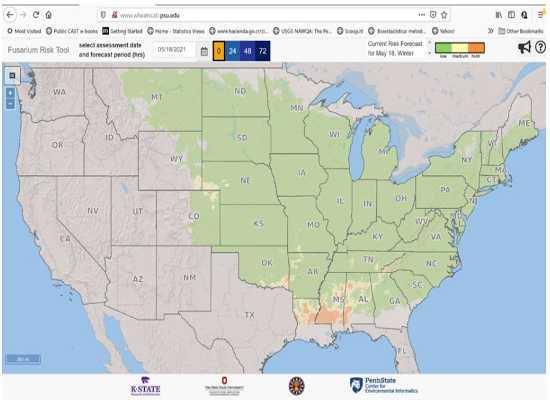
Figure 1. Risk of Fusarium head blight in wheat on May 18, 2021.
We also wanted to mention that we have received questions about tank-mixing other compounds with fungicides applied at flowering. It is always important to check the label closely to see what compounds may be tank mixed and if there could be an incompatibility issue. Nonetheless, in our research trials, we have not conducted these types of trials, given that our focus has been on understanding which compounds and timings provide the best control for FHB. Furthermore, following integrated management principles, we also have not noted anything unusual in the fields that would warrant the need for such applications. To date in 2021, we have not seen any heavy pest pressures.
Source : psu.edu