Farms.com Home   News

New Counties Confirmed for Soybean Gall Midge in Iowa

By Erin Hodgson

My lab has been driving all over western Iowa looking for soybean gall midge. They stop by 3-6 fields in each county and scout for larvae along field edges. This is part of a larger effort funded by the North Central Soybean Research Program to better understand the current distribution of this new pest.

So far, we’ve sampled 30 counties this summer and found soybean gall midge in every county. Most fields are at low infestation levels and would be difficult to confirm without splitting stems open. Some fields do not have larvae. As of today, we have confirmed infestations in three new counties: Emmet, Adams, and Taylor. My crew will continue to scout more central counties this month.
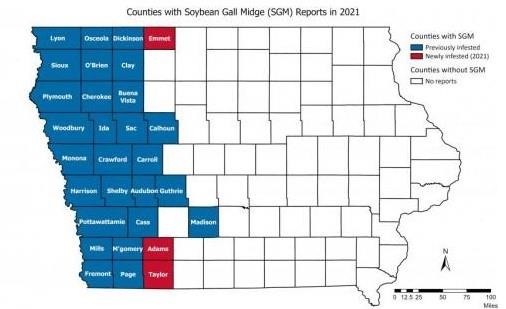
Map

Like in previous growing seasons, infested plants are first detected along field edges. Look for wilted plants and take a closer look at the base of the stem. Spilt the stem to look for larvae feeding inside.

Source : iastate.edu

Trending Video

Wheat Futures Head for the Moon on Escalating Drought Concerns

Video: Wheat Futures Head for the Moon on Escalating Drought Concerns


???? Wheat surges on drought: Prices jumped to multi-week highs as worsening dryness grips the Plains, with 70% of winter wheat in drought. Corn edged higher, while soybeans slipped.

??????? Mixed weather pattern: Rain improved parts of the Corn Belt, but drought worsened elsewhere—especially the High Plains and Kentucky. Nebraska conditions sharply deteriorated, with 56% in extreme drought.

????? Oil spikes on tensions: Crude climbed over 3% near $96 as Iran keeps the Strait of Hormuz restricted, while fragile ceasefires keep geopolitical risk elevated. ???? Pulses gain favor: Farmers are shifting to peas and lentils as a rare profit opportunity, driven by strong protein demand and lower input costs.

???? Exports mixed but solid: Corn sales dipped week-over-week but remain strong overall; soybean and wheat sales showed mixed trends, with steady global demand.