In the strawberry nursery industry, a nursery's reputation relies on their ability to produce disease- and insect-free plants. The best way to produce clean plants is to start with clean planting stock. Many nurseries struggle with angular leaf spot of strawberry, a serious disease that can result in severe losses either by directly damaging the plant or indirectly through a violation of quarantine standards within the industry.
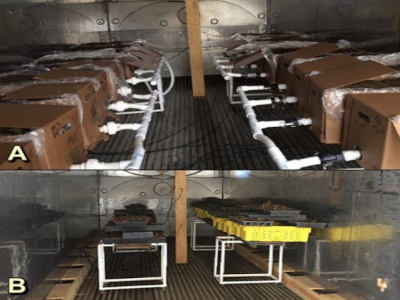
A, The precision thermotherapy unit setup for the high-elevation nursery trial in 2016. The extended setup allowed treatment of 18 boxes and employed four vacuums. B, The setup used for the trials run at Escalon and Ballico in 2017. A similar setup was used for the grower-run trial in 2018.
Angular leaf spot is caused by the bacterial pathogen Xanthomonas fragariae. Current management strategies rely primarily on the application of copper compounds after planting. Aside that these compounds are not applied until after the pathogen has had some time to establish, these products are also short-lived and can result in phytotoxicity.
Heat is another technique used to kill pathogens in plants and is typically applied prior to planting when the pathogen population is presumably at its lowest. However, heat treatments are often too harsh on plants, stunting their growth or killing them. Heat can also further spread pathogens if applied as a hot water treatment.
"One of the main problems with using heat to treat plants is that the temperature is also damaging to the tissues of most plants," explained Bill Turechek, a plant pathologist at the USDA in Florida. "This is why heat treatments are most often applied as seed treatments or on dormant woody tissues that tend to be more tolerant of the treatment."
Turechek and colleagues set out to develop a new heat-based treatment that would kill pathogens without hurting the plant. When asked what most excited them about their research and their new method, Turechek responded, "That it works! By introducing a lower-temperature conditioning step and using steam rather than hot water, we produced plants that were better able to withstand the higher temperature treatment designed to destroy the pathogen."
The new method uniquely uses a two-step process. The first step is a conditioning heat treatment that induces production of protective proteins and other molecules in the plant. The second step involves the application of a lethal temperature that kills the pathogen while doing little damage to the plant. This method, which applies heat via aerated steam, also reduces the spread of pathogens that might not have been killed in hot water treatments and subsequently dispersed in the bath water.
Click here to see more...