By Glynn T. Tonsor
In the midst of this year’s fall calf crop marketing process it is useful to step back and note marketing prospects and options available to buyers and sellers of calves. For context note the current projected price of selling a 550 lb calf in Salina, KS on October 19th is $137.28/cwt. The main marketing alternatives available include selling at weaning, preconditioning, backgrounding, dry lot wintering, and winter grazing.
To provide further context on current market signals the Value of Gain (VOG) projections provided by BeefBasis.com are provided in Table 1.[1] These estimates were derived for the Salina, KS market and include an adjustment of $3.18/cwt to reflect pending adjustments in the CME Feeder Cattle settlement index.[2]
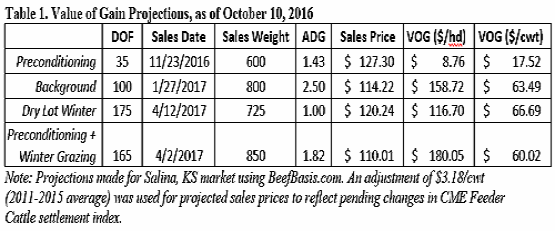
The projected VOG for preconditioning at first glance appears very poor at $17.52/cwt ($8.76/hd). However, it is important to note this projection presumes no premium at marketing. Recent research suggests that an average premium of $3.27/cwt may apply when vaccination and weaning claims are both made at marketing.[3] If a producer proactively marketed their preconditioned calves achieving this premium then the projected VOG increases to $56.76/cwt ($28.38/hd).
Prospects for longer ownership efforts of backgrounding, dry lot wintering, or combining a preconditioning and winter grazing program currently have VOG projections of $60-$66/cwt. When one couples these projections with the current wheat (and broader grain complex) market situation, it seems probable that a higher share of cattlemen will seriously consider engaging in winter graze out (rather than just winter grazing). Producers planning to graze out wheat are encouraged to repeat this exercise and derive updated VOG projections post-placement as critical dates approach of when cattle would have to be removed to retain a marketable grain crop.
It likely goes without saying at this point but any effort at delaying cattle sales, or purchasing cattle for later sale at heavier weights, exposes an operation to both down- and up-side price risk. Many cow-calf producers are understandably disappointed with their current calf price prospects which may lead them to retain ownership longer than originally planned. Only time will tell if that strategy proves profitable. In the meantime, all producers are encouraged to conduct analyses such as the one shown here to compare market based VOG projections with their own production costs to guide more informed decisions.
[1] http://www.beefbasis.com/VOG.aspx
[2] A map showing alternative market locations in the BeefBasis.com database is available here: http://www.beefbasis.com/BasisLocation_8.aspx. Producers are encouraged to identify and utilize information for the market closest to their operation.
[3] Source: http://www.waeaonline.org/UserFiles/file/JARESeptember20163Mallory393-405.pdf
Source: osu.edu