Farms.com Home   News

Number Of Low-income, Low-supermarket-access Census Tracts In Urban Areas Rose From 2010 To 2015, But Declined In Rural Areas

Efforts to encourage Americans to improve their diets presume that a wide variety of nutritious foods are available to all. But, for some areas and people, access to healthy food may be limited by the lack of supermarkets and financial resources. ERS’s Food Access Research Atlas allows users to map low-income and low-supermarket-access (LILA) census tracts in 2010 and 2015.

One access measure considers a low-income tract to be LILA if at least 500 people, or at least 33 percent of the population, live more than 1 mile from the nearest supermarket in urban tracts or more than 10 miles in rural tracts. Between 2010 and 2015, the number of urban LILA tracts increased by 5 percent, while the number of rural LILA tracts decreased by 5 percent.

Much of the increase in urban LILA tracts is attributed to a rise in the number of low-income areas—perhaps a casualty of the 2007-09 recession—rather than reduced access. This chart is from "Low-Income Areas With Low Supermarket Access Increased in Urban Areas, But Not in Rural Areas, Between 2010 and 2015" in ERS’s Amber Waves magazine, April 2017.
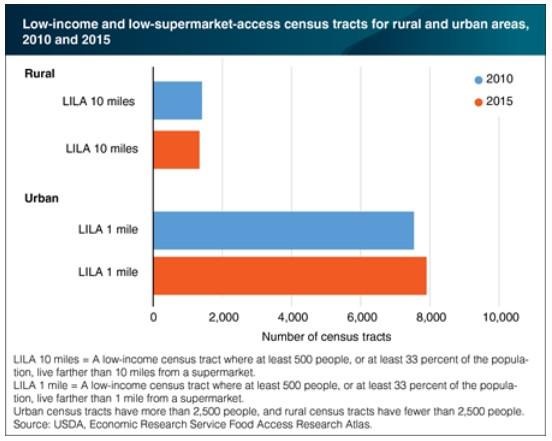
Number of low-income, low-supermarket-access census tracts in urban areas rose from 2010 to 2015, but declined in rural areas

Source:usda.gov


Trending Video

How Swine Nutrition Can Revolutionize Biogas Production - Dr. Felipe Hickmann

Video: How Swine Nutrition Can Revolutionize Biogas Production - Dr. Felipe Hickmann


In this episode of The Swine it Podcast Show Canada, Dr. Felipe Hickmann from Laval University explores how nutritional strategies and manure management impact biogas production in pig farming. He breaks down the science behind anaerobic digestion at low temperatures and explains how dietary adjustments affect methane production and environmental sustainability. Learn how producers can reduce emissions and improve resource efficiency. Listen now on all major platforms!

"Lowering crude protein can reduce nitrogen in manure, but only if animal intake doesn’t compensate by increasing feed consumption."

Meet the guest: Dr. Felipe Hickmann / felipe-hickmann-963853a6 is a PhD research assistant at Laval University, specializing in swine and poultry sustainability. With extensive experience in manure management, nutritional strategies, and precision livestock technologies, he contributes to improving environmental outcomes in animal agriculture.