It takes a long time, up to several decades, before the benefits of organic farming take full effect on land that was previously cultivated conventionally, a new study from Lund University suggests. After thirty years, the plant species richness around the cultivated crop had doubled on organic farms compared to conventional farms.
It is well known that organic farming benefits biodiversity and can mitigate some of the negative effects that arise from farming. What is less known, however, is how long it takes for biodiversity to recover after a transition from conventional to organic farming and how significant the recovery will be.
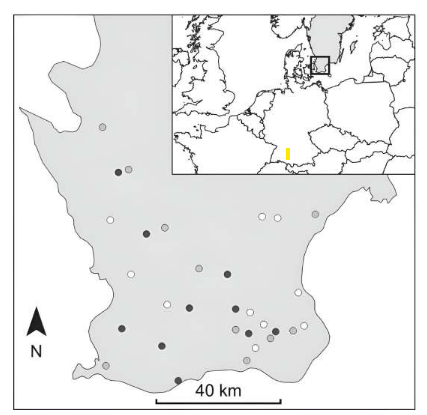
To seek answers, a research team from Lund University investigated 88 different fields in southern Sweden, on 30 different farms. The results show that after thirty years of organic farming, the number of arable plant species had more than doubled in the fields of the organic farms, from an average of 15 to 35 plant species.
The study is published in the Journal of Applied Ecology.
"We were surprised by the sharp increase in the number of plant species. After thirty years, we weren't expecting that, and it looks like it may continue to increase," says Romain Carrié, researcher at Lund University who led the study.
The fact that it took so long for the recovery, and that the improvement in biodiversity continued gradually over several decades, is something that must be kept in mind when evaluating the benefits of organic farming, say the researchers.
"If it takes a while before organic farming's full potential for biodiversity hits, we might have underestimated the benefits that organic methods provide so far. Our results indicate that one must take into account a certain delay after a transition in order not to underestimate the benefit to the environment," says Carrié.
The time aspect must also be included when designing financial support for farmers, he believes, so that they are backed up during the transition phase when yield-increasing ecosystem services, which are dependent on arable plant diversity, are built up.
In the study, it was clear that plants sensitive to herbicides took longer to establish in cereal fields after a switch from conventional agriculture.
"This could mean there is a long-term effect of herbicides even after farmers stop using them on the farm, or that it takes time for these plants to colonize the farm when it has become organic," says Carrié.
At the same time, it was the species that are most sensitive to herbicides that contributed the most to the recovery of the plant community over time in organic farming.
Click here to see more...