By Will Secor
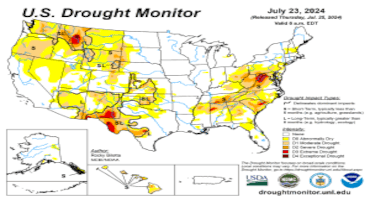
Pasture and rangeland conditions in the U.S. remain close to year-ago levels this week. Approximately 30 percent of pasture and rangeland are in poor to very-poor conditions. However, these conditions are not uniform across the U.S. Drought gripped the Southeast U.S. starting in June and has continued into July. More than 60 percent of the Southeast (AL, FL, GA, NC, SC, and VA) is experiencing drought. These drought conditions have hurt pasture and rangeland conditions in the Southeast. According to the USDA in mid-July, about 30 percent of the pasture in the Southeast (AL, AR, FL, GA, KY, LA, MS, NC, SC, TN, VA, WV) are in poor or very poor condition.
Some drought conditions exist in other areas of the country, as well, including approximately half of Texas, 60 percent of Oklahoma, 70 percent of Tennessee, and over 90 percent of Wyoming and Montana. Approximately 25 percent of Oklahoma and Texas pasture and rangelands are in poor or very poor condition. The Great Plains states are in better condition with around 20 percent of pasture and rangelands in the same condition.
These stable pasture and rangeland conditions year-over-year set the groundwork for a rebuild. With improved forage availability and lower feed costs, the ability of producers to expand their herds profitably increases. However, there are many factors that will play a key role in these rebuild decisions on an operation-by-operation basis, including expected future profitability, interest rates, land availability and other input cost changes.
Drought in certain areas and improved conditions in other areas creates uncertainty to the feeder cattle and calf price outlook for this fall. If drought incentivizes producers to bring more calves to market compared to normal, calf prices may see a more pronounced seasonal dip this fall in those areas, while still remaining high compared to recent history. However, in areas with good conditions, calf supplies may remain tight this fall, pushing prices higher than expected.
Source : osu.edu