The Association of Equipment Manufacturers (AEM), in partnership with the American Soybean Association, CropLife America, and National Corn Growers Association, released a study quantifying how widely available precision agriculture technology improves environmental stewardship while providing economic return for farmers.
Precision agriculture leverages technologies to enhance sustainability through more efficient use of critical inputs, such as land, water, fuel, fertilizer, and pesticides. Farmers who use precision agriculture equipment use less to grow more.
The Environmental Benefits of Precision Agriculture study highlights how policies and technological advancements can help farmers increase these outcomes.
“We are living in a new age of agriculture, and today’s precision technology on equipment can have an enormous positive impact on farmers and the environment,” said Curt Blades, Senior Vice President of Agriculture at the Association of Equipment Manufacturers. “One of our goals at AEM is to encourage the adoption of these technologies by more farmers, so they can all reap the benefits as we continue to focus on sustainability.”
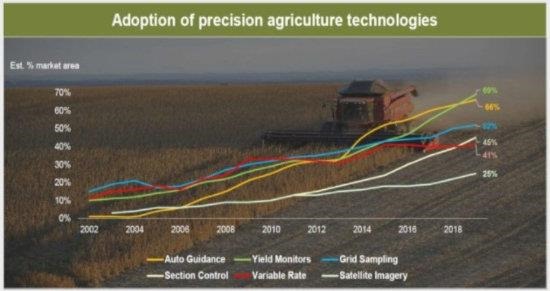
Precision agriculture technologies have contributed significantly to the increases in yields for the major crops grown in North America. Source: Association of Equipment Manufacturers and USDA NASS, Purdue Precision Ag Dealership Survey, Context Analysis and Expert Input.
Environmental Benefits
The study explores five key environmental stewardship benefits achieved through precision agriculture technology adoption, including:
- Yield benefit through increased efficiency
- Fertilizer reduction by more precise placement
- Pesticide reduction by more accurate application
- Fuel savings due to less overlap and better monitoring
- Water savings through more accurate sensing of needs
Part of Climate Answer
“The reductions in greenhouse gases this study illustrates shows modern agriculture is part of the climate solution,” said Kellie Bray, CropLife America (CLA) Chief of Staff. “Fuel savings alone due to precision ag tools is the yearly equivalent of taking nearly 200,000 cars off the road, all while preventing an area equal to 4.5 Yellowstone National Parks from being added to production because of yield increases.”
Study Highlights
As precision agriculture equipment and technologies are more widely adopted it will lead to significant increases in yields and further input savings: Significant increases in yields and further input savings can be reached as precision agriculture technologies become more widely adopted:
- Productivity has increased an estimated 4% and has the potential to further increase 6% with broader adoption.
- Precision agriculture has improved fertilizer placement efficiency by an estimated 7% and has the potential to further improve an additional 14%.
- Herbicide use has been reduced by an estimated 9% and has the potential to further decrease 15% at full adoption.
- Fossil fuel use has decreased an estimated 6% with the potential to further decrease 16%.
- Water use has decreased an estimated 4% because of current precision agriculture adoption with the potential to further decrease 21% at full adoption.
Click here to see more...