The latest weekly Canfax cattle market report is released, and prices are lower virtually across the board for the week ending October 15
According to Canfax numbers, 21,018 head of cattle were sold in the province, down slightly from the 23,970 sold the previous week, but higher than the 15,513 head sold during the same week in 2020.
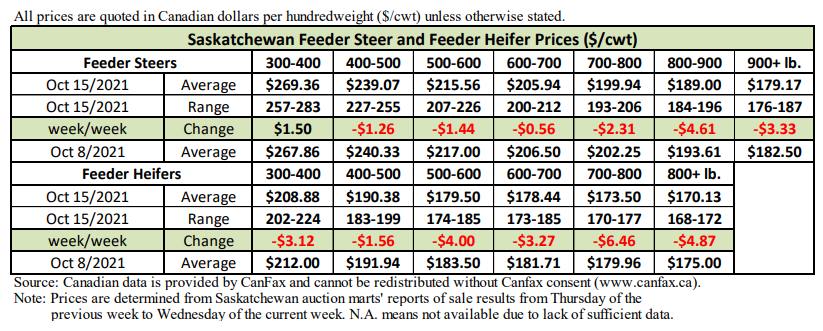
Price-wise, feeder steers were lower for the majority of price weight categories compared to the previous week (below). The only exception to that was the lowest 300-400 lb weight category, which saw a $1.50 increase. The largest price decline on the week came in the 800-900 lb weight category, which dropped $4.61 to average out at $189 dollars per hundred-weight (CWT).
Feeder heifers saw a similar drop, this time across all weight categories, with the largest decline in price coming in the 700-800 weight category, dropping $6.46 to an average of $173.50 CWT.
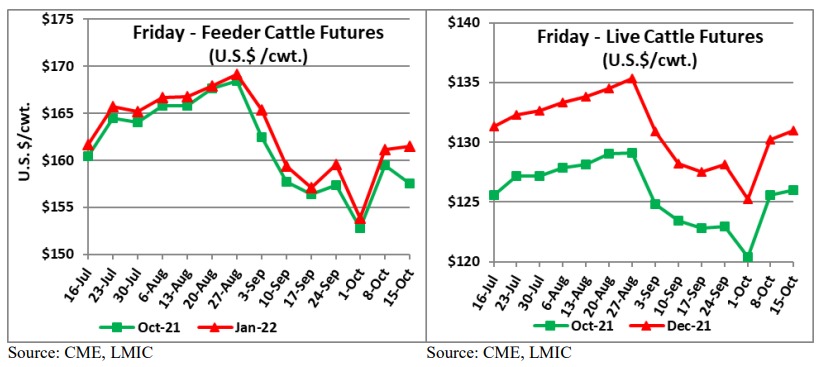
 Meanwhile, nearby feeder cattle futures saw a decline to end the week, dropping $1.90 per CWT to $157.58. Live cattle futures began the week on a similar downward trend, but pulled up on Thursday and Friday to end the week slightly above, climbing to $125.98 CWT. (below)
 Prices of live, non-fed cattle in Alberta were lower week-over-week. The price of D2 slaughter cows saw a noticeable decline of $3.37 per CWT from last week to an average of $75.80 per CWT; while the price of D3 slaughter cows saw a similar price decline of $3.36 to $66.07 per CWT.
Choice beef cutout prices (600-900 lb.) for the week averaged US$280.55 per cwt, down US$5.87 per cwt from US$286.42 per cwt the previous week, a decrease of 2.0 percent. However, the choice beef cutout value is still 32.5 percent higher than the same week a year ago when it was valued at $211.74.
Click here to see more...