USDA released its December World Agricultural Supply and Demand Estimates (WASDE) report Dec. 9, 2022, that included no obvious changes for global and domestic wheat markets. Given the overall volatility in 2022, a somewhat calming report was probably a blessing in disguise for wheat buyers who should, however, keep an eye on declining global stocks and exportable supplies.
Each month, U.S. Wheat Associates (USW) updates a graphic summary the WASDE report that includes global wheat market factors, major country and regional export history, and U.S. wheat supply and demand summaries by class. Readers can review the report online here. Some highlights from the December report follow.
Stocks to Fall
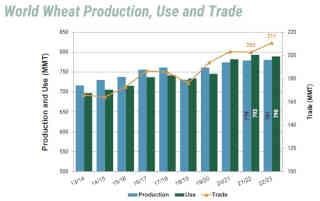
Based on USDA’s latest global wheat production estimate of 781 million metric tons (MMT) and total use of 790 MMT, marketing year 2022/23 will be the third in a row and the fourth in the last five years in which use has exceeded production.
The WASDE report included a 500,000 metric ton drop in estimated global wheat stocks to 267.3 MMT. If realized, those supplies will be the lowest since 2013/14. Of that total, an estimated 54.5 MMT will be found in “Exporter” countries, 68.4 MMT will be in “Importer” countries and 144 MMT will be in China. That means 54% of global ending stocks are locked out of world trade, an amount that is up from USDA’s estimate of about 51% in December 2021.
Low Exportable Supplies
In a video presentation on World Wheat Supply and Demand recorded for 2022 USW Crop Quality Seminars, USW Vice President and West Coast Office Director Steve Wirsching showed that ending stocks among exporting countries have declined significantly over the past five years.
“When exporters hold so few stocks, this increases market volatility and leads to higher wheat prices,” Wirsching said. A condition made even more uncertain by Russia’s on-going incursion into Ukraine.
Trade Volume to Increase
The world wheat trade estimate increased in December 2.2 MMT to 210.9 MMT. December’s report suggests higher exports from Ukraine, Russia and the EU
Click here to see more...