Today, John Deere secondary tillage equipment has cutting-edge technology that makes the average farmer more efficient than ever before.
Features such as John Deere FarmSight and John Deere Implement Detection have reduced the time it takes to jot down measurements, connect equipment and monitor machine performance. Let’s take a look at five pieces of secondary tillage equipment that have improved the way that agricultural professionals do business.
1. 2210 Field Cultivator
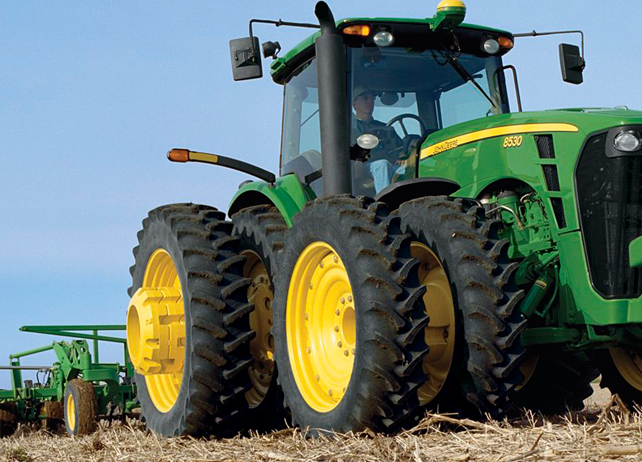
The 2210 Field Cultivator from John Deere uses significant less horsepower per foot when compared to most secondary tools on the market. It also has wider implements — working widths range from 20 feet and 6 inches to 64 feet and 6 inches. Its operating speed ranges from 5 to 8 miles per hour. Additionally, its new High Productivity feature eliminates weeds in a short amount of time.
2. 2310 Mulch Finisher
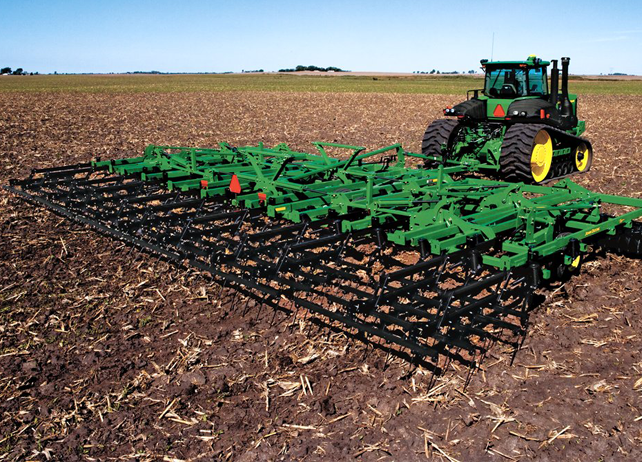
The John Deere 2310 Mulch Finisher is designed to root out weeds, till and condition soil, and level soil surface. Its 2600 Series Disks offer working widths up to 45 feet 9 inches. The machine combines disking and field cultivation, and it is designed to handle a large amount of residue.
3. 2623 Disk
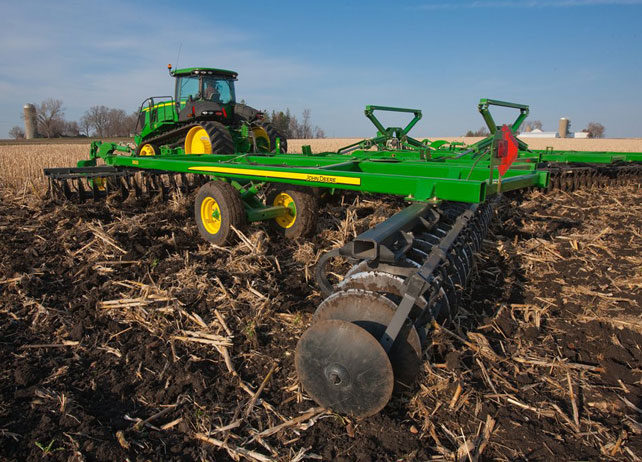
The 2623 Disk from John Deere is a part of the 2600 Series Disks, which can be used for secondary tillage machinery. The 2623 Disk can be utilized for seedbed preparation in the spring, or it can be put into action during heavy residue conditions in the fall. It has working widths up to 49 feet 3 inches, as well as heavyweight blades to take on rough terrain once autumn arrives. As a bonus, it can level soil and reduce clod size along the way.
4. 2623VT
The 2623 from John Deere is a vertical tillage machine that helps producers size residue and mix soil efficiently. The machine has 7.25-inch blade spacing to work at high speeds while chopping and sizing residue. It also has operating speeds between 7 and 10 miles per hour. Additionally, it has a 21-degree front and 19-degree rear gang angle to manage weeds proficiently.
Click here to see more...