Farms.com Home   News

Recommendations for Soybeans Planted in June

Recommendations for Soybeans Planted in June

By Laura Lindsey

According to the USDA National Agricultural Statistics Service, 66% of soybean acreage in Ohio was planted by May 23. As soybean planting continues into June, consider row spacing, seeding rate, and relative maturity adjustments.

Row spacing. The row spacing for June planting should be 7.5 to 15 inches, if possible. Row width should be narrow enough for the soybean canopy to completely cover the interrow space by the time the soybeans begin to flower. The later in the growing season soybeans are planted, the greater the yield increase due to narrow rows.

Seeding rate. Higher seeding rates are recommended for June plantings. The final (harvest) population for soybeans planted in June should be 130,000 to 150,000 plants/acre. For May planting dates, a final stand of 100,000 to 120,000 plants/acre is generally adequate. (For more information on soybean planting date and seeding rate interactions see this video: https://www.youtube.com/watch?v=6pqQSB4VBBQ&t=1463s starting at minute 8:00.)

Relative maturity. For June planting dates, select the latest maturing variety that will reach physiological maturity before the first killing frost. This is to allow the plants to grow vegetatively as long as possible to produce nodes where pods can form before vegetative growth is slowed due to flowering and pod formation. The recommended relative maturity ranges are shown in the table below.
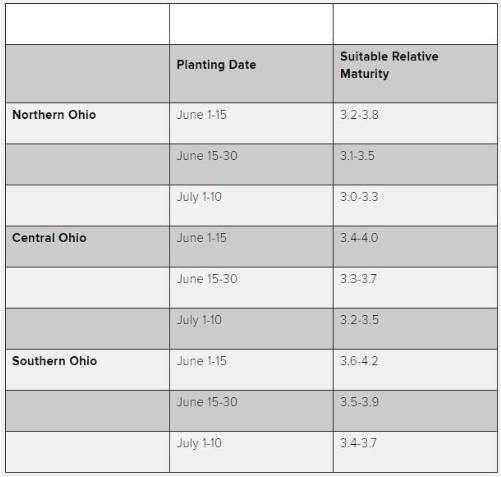
Recommendations for Soybeans Planted in June

Source : osu.edu

Trending Video

Democratizing Gene Editing - Pairwise’s Vision for the Future of Agriculture

Video: Democratizing Gene Editing - Pairwise’s Vision for the Future of Agriculture

Pairwise has built its business around an idea that runs counter to how many companies approach innovation: make transformative technology easier to access.

In this Seed World interview, CEO Tom Adams discusses why broader access to gene editing could speed crop improvement, expand innovation opportunities and help agriculture address emerging challenges. He explains why Pairwise believes no single company can solve all of agriculture's problems alone—and why making advanced breeding technologies available to more organizations could accelerate progress across the industry.

The conversation explores how consumer trust influences technology adoption, why innovations like pitless cherries and seedless blackberries matter beyond convenience, and how future crop improvements could help address labor shortages, automation, harvest efficiency and other production challenges. Adams also shares his perspective on what the industry may be underestimating about the next wave of gene editing innovation.

Watch the full interview to hear why Pairwise believes agriculture is approaching an important inflection point for gene editing, and why the pace of innovation over the next decade could surprise the industry.

Topics Covered:

o Democratizing agricultural innovation

o Consumer trust and technology adoption

o The business case for sharing innovation

o Expanding innovation beyond major crops

o Next-generation breeding technologies