By Greg Henderson
By now you’ve probably seen photos of empty grocery store meat cases caused by consumer panic buying over the COVID-19 pandemic.
210 Analytics LLC says meat department sales without deli surged by 76.9% over the week ending March 15, 2020, based on data from IRI.
Anne-Marie Roerink, principal and founder of 210 Analytics, a research and analytics firm, said, “During the week ended March 15, turkey registered the highest growth, nearly doubling dollar sales (+96.1%). Lamb increased sales by more than 50%. Beef and chicken, by far the largest categories, increased sales by $376 million and $183 million, respectively.” Fresh pork was up 89.2%.
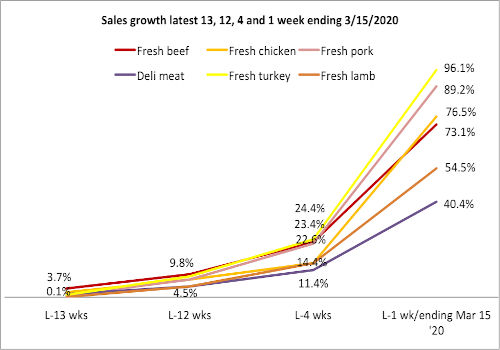
IRI found that for 12 weeks in 2020 prior to March 15, fresh beef sales increased 9.8%.
“Volume sales for the week of March 15 were up 68.7%, made possible by processing plants ramping up capacity and distributors diverting supply from foodservice to food retail,” Roerink says. “Amid the growing number of COVID-19 cases across the country, shoppers prepared for prolonged stays at home, working from home and restaurant closures.”
Growth drivers
In absolute dollars, the five biggest winners for the week of March 15 were ground beef (+$179.1 million), chicken breasts (+$89.5 million), pork loin (+$36.9 million), chuck ($36.3 million) and ribeyes (+$31.6 million), according to IRI. The top 10 items were closed out by beef round and short loin, ground turkey, recipe-ready beef and chicken wings.
But even if the COVID-19 pandemic stretches over months, there should be no big food shortages, especially on staples like milk, eggs, cheese, bread and meat, according to three supply chain experts who spoke to CNBC.
“All the grocery stores are going to have pallets of toilet paper sitting in the aisles, and nobody is going to buy it, because who needs to buy toilet paper when you’ve got a year’s worth sitting in your garage?” Daniel Stanton, a supply chain expert and author of “Supply Chain Management for Dummies,” told CNBC.
But he’s not worried Americans will run out of food.
“The U.S. produces a huge amount of food. We’re also an exporter of food, so we’re going to be okay,” Stanton said.
Source : osu.edu