Farms.com Home   News

Scout Field Corn For Stink Bugs

Last year (2016) did not prove to be as bad for stink bugs as 2015, but there were some “hot spots” in the region.  This year (2017) appears to be a fairly active year for stink bugs in field corn in northeast North Carolina.  The main point for addressing this topic is to get it on your “radar”.
 
Because of the less than ideal conditions for corn planting, we have corn that ranges from only a few weeks emerged to corn that is silking and tasseling.  The two major times that stink bugs cause damage to field corn is V2 to V8 growth stage or the pre-tassel growth stage.
 
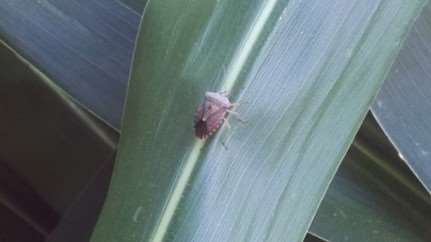
With wheat being harvested, some people are seeing a lot of stink bugs. The stink bug that is a pest of corn is the brown stink bug.  If you have corn in the V2 to V8 stage, the growing point of the corn plant is susceptible to damage by the stink bug as it probes the seedling plant with its piercing mouth part.  At this stage, the threshold is one stink bug per ten plants.  For corn that is at the pre-tassel stage, the damage by the stink bug occurs when it pierces the leaf and the developing ear, which has not yet emerged.  For corn at the pre-tassel stage, the threshold is 1 stink bug per 4 plants.  Although the stink bug can damage the individual kernels once the ear has emerged from behind the leaf, its greatest impact is when it pierces the small developing ear.  This damage can cause misshapen ears.
 
Although stink bugs could be found in most any corn field, the situations where they are more likely to be found are corn fields next to wheat fields that have been harvested recently, next to weedy farm paths and ditches, as well as hedgerows.  The main point is to scout your corn fields.
 
From tests conducted by Dr. Dominic Reisig, Entomologist, North Carolina State University, the pyrethroid of choice for controlling the brown stink bug is bifenthrin.
 
If you have questions about stink bugs in field corn, contact your local Extension Center. Additional information can be found at the following link:


Source: ncsu.edu


Trending Video

Spring 2026 weather outlook for Wisconsin; What an early-arriving El Niño could mean

Video: Spring 2026 weather outlook for Wisconsin; What an early-arriving El Niño could mean

Northeast Wisconsin is a small corner of the world, but our weather is still affected by what happens across the globe.

That includes in the equatorial Pacific, where changes between El Niño and La Niña play a role in the weather here -- and boy, have there been some abrupt changes as of late.

El Niño and La Niña are the two phases of what is collectively known as the El Niño Southern Oscillation, or ENSO for short. These are the swings back and forth from unusually warm to unusually cold sea surface temperatures in the Pacific Ocean along the equator.

Since this past September, we have been in a weak La Niña, which means water temperatures near the Eastern Pacific equator have been cooler than usual. That's where we're at right now.

Even last fall, the long-term outlook suggested a return to neutral conditions by spring and potentially El Niño conditions by summer.

But there are some signs this may be happening faster than usual, which could accelerate the onset of El Niño.

Over the last few weeks, unusually strong bursts of westerly winds farther west in the Pacific -- where sea surface temperatures are warmer than average -- have been observed. There is a chance that this could accelerate the warming of those eastern Pacific waters and potentially push us into El Niño sooner than usual.

If we do enter El Nino by spring -- which we'll define as the period of March, April and May -- there are some long-term correlations with our weather here in Northeast Wisconsin.

Looking at a map of anomalously warm weather, most of the upper Great Lakes doesn't show a strong correlation, but in general, the northern tiers of the United States do tend to lean to that direction.

The stronger correlation is with precipitation. El Niño conditions in spring have historically come with a higher risk of very dry weather over that time frame, so this will definitely be a transition we'll have to watch closely as we move out of winter.