By Elizabeth Danielson
When selecting a pesticide, make sure you read the label to ensure that you have the Personal Protective Equipment (PPE) neededimage of types of personal protective equipment to mix, load, and apply that product.
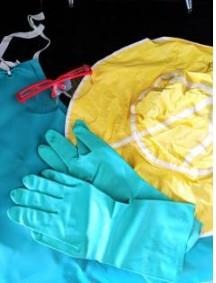
The PPE that must be worn is found in the "Precautionary Statements" section of the pesticide label. If two or more pesticides are used at the same time, you must use the PPE from the pesticide label that is most restrictive or that requires the most protective PPE. If the label does not refer to PPE, wear work clothing that protects you from contact with pesticide residues - a long sleeve shirt, long pants, shoes, and socks.
Types of PPE
PPE includes gloves, coveralls and chemical-resistant suits, protective eyewear, respirators, headgear, aprons, and footwear. “Chemical-resistant” refers to materials that allow no measurable movement of the pesticide through the material.
Gloves
Gloves must be either waterproof or chemical-resistant. Examples of chemical-resistant gloves include neoprene rubber, butyl rubber, polyvinyl chloride (PVC), Viton®, barrier laminate or nitrile rubber. Some labels will note the required glove thickness (e.g., nitrile rubber ≥ 14 mils). Do not wear flocked or lined gloves because the lining can absorb pesticides.
Coveralls and Chemical-resistant suits
Coveralls and chemical-resistant suits must be loose-fitting, one- or two-piece garments that cover, at a minimum, the entire body except for your head, hands, and feet. When the pesticide label requires coveralls to be worn, it means cloth garments. Chemical-resistant suits are made of or coated with butyl rubber, neoprene, PVC, polyethylene, or other material. Disposable coveralls made of Tyvek® or other similar materials provide adequate protection under most conditions.
Protective Eyewear
When “protective eyewear” is specified by the product labeling, one of the following types of eyewear must be worn: goggles; face shield; safety glasses with front, brow, and temple protection; or a full-face respirator. Some labels specify that a particular type of eye protection must be worn. When goggles are required, select a pair with indirect vents for protection from splashes or non-vented for protection from gases, mists, and fumes.
Respirators
When a respirator is specified by the product labeling, it must be appropriate for the pesticide product used and for the activity to be performed. Use only respirators approved by the National Institute of Occupational Safety and Health (NIOSH).
If a pesticide product label has a “Agricultural Use Requirements” box and has language referring to the Worker Protection Standard (WPS), you must follow the WPS requirements for respirator training, medical evaluation, fit testing, and recordkeeping. Additional information on respirators can be found in the Worker Protection Standard Respiratory Protection Guide.
Headgear
When “chemical-resistant headgear” is specified by the product labeling, it must be either a chemical resistant hood or a chemical-resistant hat with a wide brim. Do not wear hats, such as baseball caps, when handling pesticides.
Aprons
The label may require a chemical-resistant apron when mixing and loading a pesticide. The apron must be long enough to cover the front of your body from mid-chest to the knees.
Footwear
Chemical-resistant boots, shoes, or shoe coverings, which prevent shoes from becoming contaminated, should be worn for pesticide work.
Sources of PPE
PPE can often be purchased from local pesticide dealers or farm supply stores in addition to the following sources:
Use each website’s search box and type in the specific type of PPE you need, e.g., barrier laminate gloves or chemical resistant gloves. Searching for general terms, such as “PPE” and “gloves,” will likely provide results that are not adequate for protection against pesticides.
Source : iastate.edu