By Adriana Murillo - Williams and Alyssa Collins
Nematodes are microscopic thread-like roundworms found in a wide range of environments, including soil and fresh and salt water. There are species of nematodes that feed on fungi, bacteria, other nematodes, and plants, while others will parasitize insects, humans, and animals. The nematodes that feed on plant parts are called plant parasitic nematodes, and they are ubiquitous in both agricultural and nonagricultural soils.
The soybean cyst nematode (SCN, Heterodera glycines) is considered the most damaging soybean pathogen in the US. In Pennsylvania, SCN has been documented in Lancaster and York Counties. Signs of infection of SCN are white-to-pale-yellow female bodies present in roots that can be seen with the naked eye (Figure 1). Nonetheless, above ground symptoms are not always obvious, and infections can go undetected until populations are well-beyond economic thresholds. SCN easily spreads through anything that moves soil and infected roots; therefore, we recommend soybean farmers scout and take soil samples to know if SCN is present in their fields.
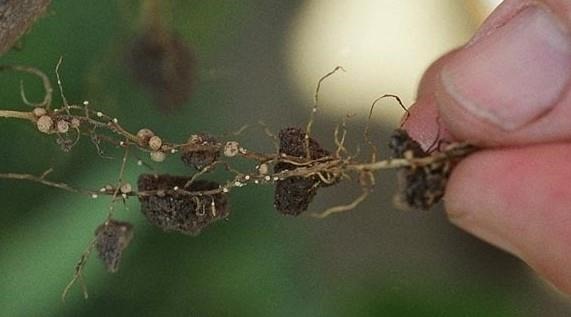
Figure 1. Soybean root with SCN females (white lemon-shaped bodies). SCN females are different from soybean nodules in size, shape, and color (Photo credit: Greg Tylka, Iowa State University)
Thanks to the support from the SCN Coalition and the Pennsylvania Soybean Board, the Penn State Extension Agronomy Team is offering free SCN testing for farmers in Pennsylvania.
How does the free SCN testing work? Soil samples for SCN can be taken anytime during the growing season if nematodes are suspected of affecting your crop. Farmers can request soil sample bags and instructions to be sent to your home address by emailing Adriana Murillo-Williams (axm1119@psu.edu) or calling 814-355-4897. You can also contact your local Penn State Extension agronomy educator.
Soil sampling for nematodes requires collecting 1-inch-diameter soil cores to a depth of 8 inches. A shovel or a hand trowel can be used when a soil probe is not available. Obtain at least 20 soil cores for areas of 20 acres or smaller. For patches of stunted and yellow plants, samples should be collected from the margin of the affected areas, avoiding the area where plants look heavily damaged. Samples can also be collected from hillsides, adjacent to waterways, field entryways, areas prone to flooding, along fence lines, low-yielding areas, near buildings where equipment is stored, and high pH areas. In the field, nematode populations are quite variable. Therefore, take as many soil cores as possible, even in smaller areas or fields. Collect the soil cores in a bucket and mix them to create a composite sample. Place at least two pints of the composite sample in a soil testing bag or a sealed plastic bag, keep it protected from direct sunlight or heat, and store it in a refrigerator until submission.
Source : psu.edu