By Damon Smith
Tar spot has been found on corn in plots established to monitor for the disease in Arlington (Columbia Co.) and Lancaster (Grant Co.) WI (Fig. 1). In both cases the disease was present on hybrids known to be susceptible. At the Arlington location disease was found in just one small area of the field. Tar spot coverage was low to moderate on a few leaves (Fig. 2). Microscopy was used to observe ascospores from stromata, thus confirming the tar spot fungus (Fig. 3).
Tar spot was very hard to find in the Lancaster location. However, it was observed on several plants in one monitoring plot. In each case only 1-2 spots were observed.
Figure 1. Corn IPM PIPE tar spot occurrence map as of August 7, 2019.
What does this mean for you?
This means it is time to get back out and scout corn fields for tar spot. If you have had a history of tar spot and you know that you have a hybrid that is more susceptible and there is a large amount of infested residue, then you should monitor this situation closely. If tar spot is observed and you are irrigating or have had frequent rain, monitor this situation very closely. Tar spot seems to progress quickly in irrigated environments. Remember, that the window of opportunity to treat with a fungicide can pass rapidly as this disease can move quickly. Protecting this ear leaves before R3 can be important for preserving yield. There are many products that have demonstrated decent efficacy toward tar spot. You can find our 2018 fungicide test summaries by
CLICKING HERE and scrolling down to pages 2-7. Work with your local extension personnel if you need help diagnosing the disease or need advice on spraying fungicides.
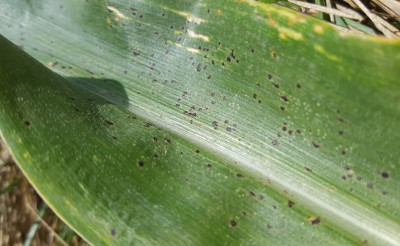
Figure 2. Tar spot on a leaf of corn located in Arlington, WI on August 7, 2019.
Figure 3. Asci and Ascospores of the tar spot fungus.