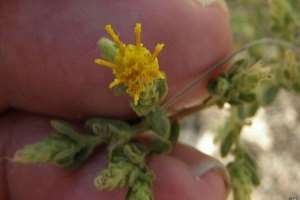
When pharmaceutical companies can’t recreate mother nature’s astounding healing abilities, they simply co-opt them. Of course, they do this so that they can patent a drug, when a real plant is freely available to the world in a non-pharmaceutical form, to make billions off of their ‘invention.’ Big Pharma’s latest attempt to profit from the offerings of the natural world comes in the form of an ancient flower. This stocky, furry-stemmed plant with yellow buds has been found to practically cure diabetes Type 2. Does the modern medical establishment promote the use of the whole flower? Nope. They can’t make any money off of that remedy. Instead they eagerly take it to a lab and start trying to mimic its ‘active’ compounds and isolate them.
Israeli scientists conducted studies on Chiliadenus iphionoides, also known as sharp varthemia. Dr. Jonathan Gorelick of the Judea Research and Development Center recently presented the published findings at a conference. They concluded that, “Chiliadenus iphionoides exhibits considerable anti-diabetic activity, although the mechanism of action remains to be determined.”
This is the rub. Scientists often can’t figure out exactly how a plant does its magical, miraculous healing, so they dissect it to bits, and create a drug. The problem is that the isolated phytoactive compounds are often either chemically reproduced, or they simply don’t account for the synergistic way that multiple plant compounds and phytonutrients work together to make a plant’s medicine efficacious.
Though scientists who studied sharp varthemia discovered the flower worked on both cellular and animal models to help control blood sugar – the researchers admit they don’t know exactly how this is possible. That didn’t stop Big Pharma from jumping on the findings to try to recreate a marketable drug.
Click here to see more...