Farms.com Home   News

U.S. Fresh Blueberry Demand Continues To Rise

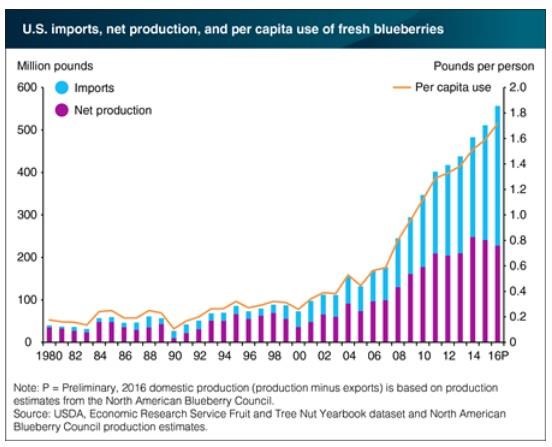
Per capita use of blueberries nearly tripled since 2006, largely attributable to growing demand based on the potential health benefits of berries in the diet. In recent years, farmers have expanded production to help meet this demand. As a result, net domestic production doubled and imports increased by almost four times.

In addition to increased demand, consumer preferences for year-round availability of popular fresh fruits and vegetables necessitates a greater reliance on imported goods. Domestic blueberry production primarily occurs in the spring and summer seasons. In the fall and winter, southern hemisphere countries like Chile are in their growing season and supply the United States with a significant share of its blueberry imports.

In 2016, net domestic production fell slightly, while imports increased. This resulted from lower than expected production in States that normally supply the fresh market like, Georgia, Florida, New Jersey, North Carolina, and California. This chart appears in the ERS Fruit and Tree Nut Outlook report released in April 2017.
U.S. Fresh Blueberry Demand Continues To Rise

Source:usda.gov


Trending Video

What Does 20 MILLION Hogs a Year Look Like?

Video: What Does 20 MILLION Hogs a Year Look Like?


?? The Multi-Plant System Processing 20 Million Hogs Annually in the Midwest JBS USA operates multiple large-scale pork processing facilities across the Midwest, including major plants in Iowa, Minnesota, and Indiana. Combined, these facilities have the capacity to process approximately 20 million hogs annually.

Each plant operates high-speed automated slaughter systems capable of processing up to 20,000 head per day, followed by fabrication lines that break carcasses into primals, sub-primals, and case-ready retail products.

Hog procurement is coordinated through electronic marketing platforms that connect regional contract finishing operations and independent producers to plant demand schedules. This digital procurement system allows for steady supply flow and scheduling efficiency across multiple facilities.

Processing plants incorporate comprehensive food safety systems, including pathogen intervention technologies, rapid chilling processes, and integrated cold-chain management. USDA inspection is embedded throughout the harvest and fabrication stages to ensure regulatory compliance and product integrity. Finished pork products — from bulk primals to retail-ready packaged cuts — are distributed through coordinated logistics networks serving domestic and export markets.