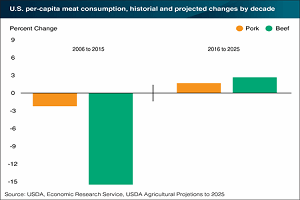
USDA baseline projections provide a long-term view of the U.S. farm sector. These projections show that production of beef and pork will expand steadily between 2016 and 2025, driven by lower feed costs and strong meat demand domestically and abroad. As a result of this greater production, beef and pork prices are projected to drop 10.6 percent and 11.6 percent, respectively, over the same period. Cheaper prices will help reverse a multiyear decline in meat consumption in the United States. Per capita consumption of beef is also forecast to increase 2.7 percent by 2025, outpacing growth in consumption of broilers (2.3 percent) and pork (1.7 percent). USDA expects this will increase the total amount of meat consumed per person in the U.S. from 211 pounds in 2015 to nearly 219 pounds by 2025. This chart appears in the ERS Amber Waves finding "U.S. Beef and Pork Consumption Projected to Rebound" released September 2016.
Source: usda.gov