Farms.com Home   News

U.S. Personal Income Higher

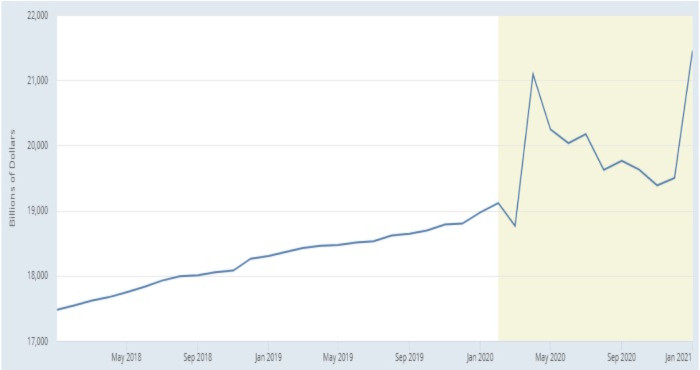
U.S. personal income continues to move higher despite the ongoing economic disruptions and unemployment caused by COVID-19. Real disposable personal income (inflation adjusted) was up 11.4 percent in January compared to December (Figure 2). Personal income consists of total earnings due to wages, investments, and other ventures. Spikes in personal income are evident in March of last year and January of this year due to the stimulus payments provided in the COVID-19 assistance packages.

Taxpayers received $1,200 per person in the first relief package, and $600 per person in the second one. For persons who did not lose a job, the vast majority, the assistance simply boosted income. It appears most people deposited the increased income into savings. The Economist reports that excess savings reached $1.6 trillion last month.

Figure 2. Total. U.S. Real Personal Income
Total. U.S. Real Personal Income

Click here to see more...

Trending Video

Evolution of Beef Cattle Farming

Video: Evolution of Beef Cattle Farming

The Clear Conversations podcast took to the road for a special episode recorded in Nashville during CattleCon, bringing listeners straight into the heart of the cattle industry. Host Tracy Sellers welcomed rancher Steve Wooten of Beatty Canyon Ranch in Colorado for a wide-ranging discussion that blended family history and sustainability, particularly as it relates to the future of beef production.

Sustainability emerged as a central theme of the conversation, a word that Wooten acknowledges can mean very different things depending on who you ask. For him, sustainability starts with the soil. Healthy soil produces healthy grass, which supports efficient cattle capable of producing year after year with minimal external inputs. It’s an approach that equally considers vegetation, animal efficiency, and long-term profitability.

That philosophy aligned naturally with Wooten’s involvement in the U.S. Roundtable for Sustainable Beef, where he served as a representative for the Colorado Cattlemen’s Association. The roundtable brings together the entire beef supply chain—from producers to retailers—along with universities, NGOs, and allied industries. Its goal is not regulation, Wooten emphasized, but collaboration, shared learning, and continuous improvement.