As of September 1, there were 77.7 million hogs and pigs on U.S. farms, up 3 percent from September 2018, and up 3 percent from June 1, 2019, according to the Quarterly Hogs and Pigs report published today by the U.S. Department of Agriculture’s National Agricultural Statistics Service (NASS).
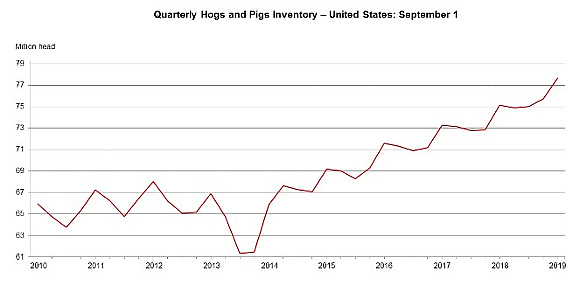
Other key findings in the report were:
- Of the 77.7 million hogs and pigs, 71.2 million were market hogs, while 6.43 million were kept for breeding.
- Between June and August 2019, 35.3 million pigs were weaned on U.S. farms, up 3 percent from the same time period one year earlier.
- From June through August 2019, U.S. hog and pig producers weaned an average of 11.11 pigs per litter.
- U.S. hog producers intend to have 3.16 million sows farrow between September and November 2019, and 3.11 million sows farrow between December 2019 and February 2020.
- Iowa hog producers accounted for the largest inventory among the states, at 24.9 million head. North Carolina and Minnesota had the second and third largest inventories with 9.50 million and 9.00 million head, respectively.
To obtain an accurate measurement of the U.S. swine industry, NASS surveyed over 5,200 operators across the nation during the first half of September. The data collected were received by electronic data recording, mail, telephone and through face-to-face interviews. All surveyed producers were asked to report their hog and pig inventories as of September 1, 2019.
Source : NASS USDA