By Bradley Zwilling
Illinois FBFM Association and Department of Agricultural and Consumer Economics
University of Illinois
In 2019, the total noncapital living expenses of 1,257 farm families enrolled in the Illinois Farm Business Farm Management Association (FBFM) averaged $78,894–or about $6,600 a month for each family (Figure 1). This average was about 1.1 percent higher than in 2018. Another $5,446 was used to buy capital items such as the personal share of the family automobile, furniture, and household equipment. Thus, the grand total for living expenses averaged $84,340 for 2019 compared with $82,578 for 2018, or a $1,762 increase per family.
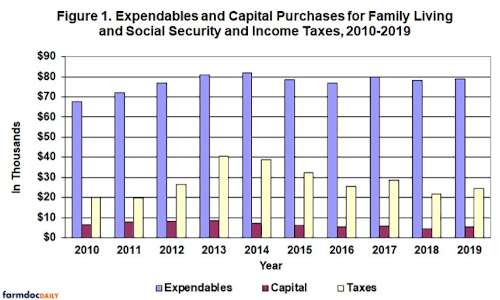
Income and social security tax payments increased 13.1 percent in 2019 compared to the year before. The amount of income taxes paid in 2019 averaged $24,525 compared to $21,692 in 2018. Net nonfarm income increased, averaging $44,871 in 2019. Net nonfarm income has increased $8,895, or 24.7 percent in the last ten years.
In Figure 2, total family living expenses (expendables plus capital) are divided by tillable operator acres for 2010 to 2019. In 2010, all of the family living costs per acre averaged about $102 per acre. This increased to $121 per acres in 2013, but has decreased to $100 per acre in 2019. $109 was the 10-year average of total family living expense per acre. If we compare this to the 10-year average of net farm income per acre of $159, then 69% of the net farm income per acre is family living expense. If we look at the average year over year increase for the last ten years for family living per acre, the annual increase was 0.1% per year. The five-year annual increase per year would average negative 2.9%. Therefore, as you work on your crop budgets, keep in mind that a $100 per acre family living is equal to a 50 cent per bushel price change on 200 bushels per acre for corn.
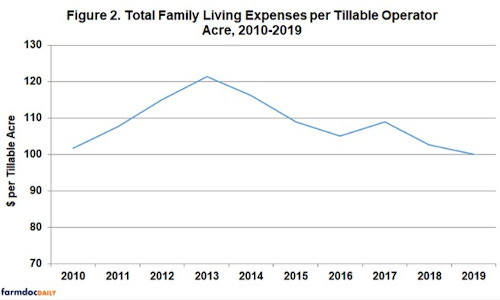
When you take total family living expenses minus net nonfarm income this equals $47 per acre in 2019 and was $51 per acre for the five-year average. This would be the part of family living that is covered by the farm income. In addition, there is another $29 per acre in social security and income taxes to be covered by the farm in 2019. The five-year average for these taxes was $33 per acre. A 24 cent price change on 200 bushels of corn per acre is equal to the 2019 family living cost that would be covered by the farm. If you added the amount of social security and income taxes that would be a 38 cent price change on 200 bushel of corn per acre.
Source : illinois.edu