If you grow soybeans and have had all or either of Canada fleabane, common ragweed and giant ragweed growing in your fields, the use of pre-plant herbicide tank-mixes will be your best chance at achieving good control of these weeds. Management options for these three weeds are either limited or do not provide acceptable control once the soybean crop has emerged.
Why are these weeds so difficult to manage? Populations of all three species exist in Ontario that are resistant to glyphosate. In addition there are also populations of Canada fleabane and giant ragweed resistant to FirstRate (cloransulam) and Classic (chlorimuron).
A little bit about Canada fleabane (known also as Mare’s Tail and Horseweed)
- Total field sites in Ontario where glyphosate resistant populations exist: 84
- Essex (56), Kent (19), Elgin (7), Lambton (1), Niagara (1)
- Tall plants (1.5 m (4′ 6″) or higher) can produce over 200,000 seeds
- Majority of seeds (~80%) will germinate upon dispersal.
- Seeds are air born and will move several hundred metres.
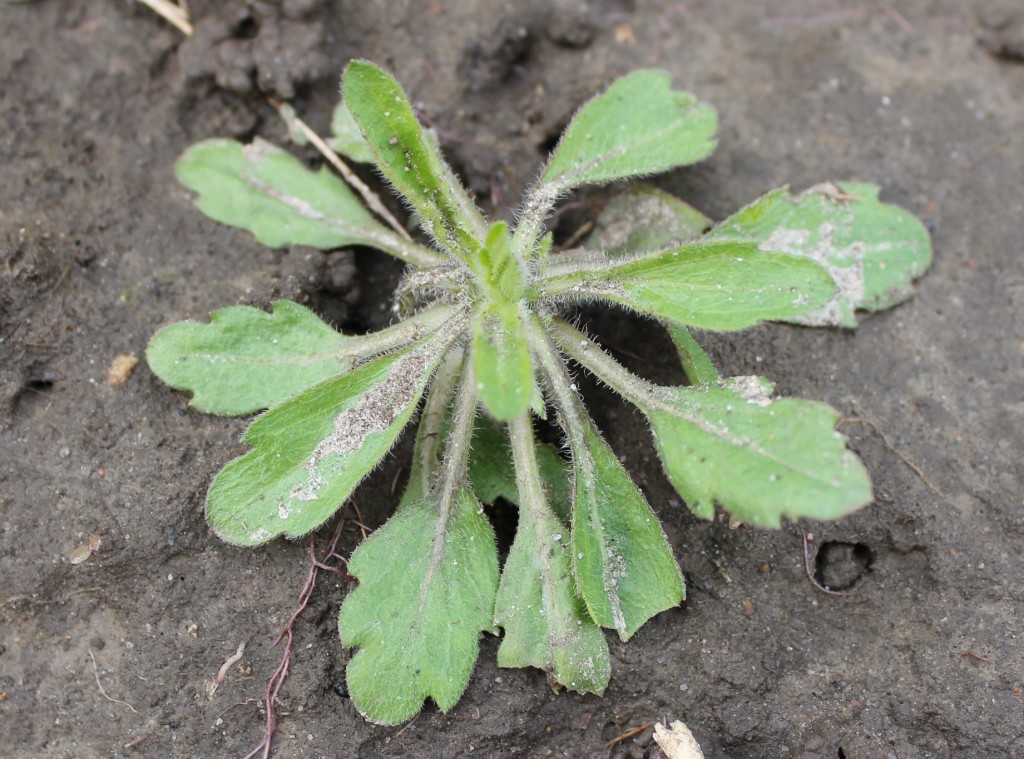
A small seedling fleabane plant shown in late August, 2011 that germinated after cereal harvest.
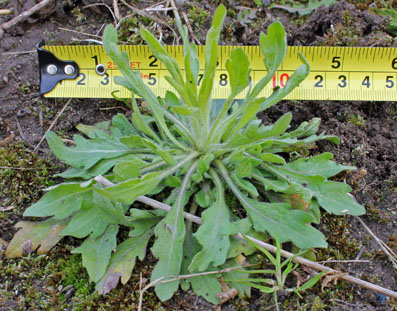
Canada fleabane size on May 24th, 2011. This is beyond the ideal stage to effectively manage with either herbicides or tillage.
Pre-plant management options for Canada fleabane:
Table 1: Visual control of glyphosate resistant Canada fleabane when herbicides with different modes of action were tank-mixed with glyphosate and applied prior to planting soybean.
Glyphosate tank-mix partner | Rate | % Control |
Sencor | 600 g/ac | 100 |
Eragon + Merge | 14.4 g + 0.5% v/v | 98 |
FirstRate* | 17 g/ac | 95 |
Amitrol 240 | 3.36 L/ac | 93 |
2,4-D LV Ester 700** | 0.32 L/ac | 86 |
Liberty | 1 L/ac | 75 |
- populations of Canada fleabane are also resistant to this herbicide.
- must be applied a minimum of 7 days prior to planting
A little bit about giant ragweed

A 2 leaf giant ragweed seedlng.

A giant ragweed plant past the ideal stage for control with a herbicide.

A giant ragweed plant unaffected by 12 times the normal field rate of glyphosate. Source: Peter Sikkema
- Total field sites in Ontario where glyphosate resistant populations exist: 64
- Essex (64), Kent (5), Lambton (5), Lennox & Addington (1), Middlesex (1)
- Considered one of the most competitive species in Ontario.
- Female plants (seed producing) are wind pollinated by male plants.
- Wind born pollen can travel several kilometers.
- Pre-plant management options for giant ragweed:
Table 2: Visual control of glyphosate resistant giant ragweed when herbicides with different modes of action were tank-mixed with glyphosate and applied prior to planting soybean.
Glyphosate tank-mix partner | Rate | % Control |
2,4-D LV Ester 700* | 0.32 L/ac | 96 |
Eragon + Merge | 14.4 g + 0.5% v/v | 87 |
FirstRate** | 17 g/ac | 84 |
Data based on 7 studies, except FirstRate data which was based on 8 studies
* populations of giant ragweed are also resistant to this herbicide.
**must be applied a minimum of 7 days prior to planting
Source: Fieldcrop