Farms.com Home  › News

Soybean Gall Midge Adults Detected in South Dakota

By Adam Varenhorst

Soybean gall midge emergence was first detected in South Dakota two weeks ago, during the week of June 13 -17. Emergence continues to be slow in South Dakota, with the only observations in southeast South Dakota.
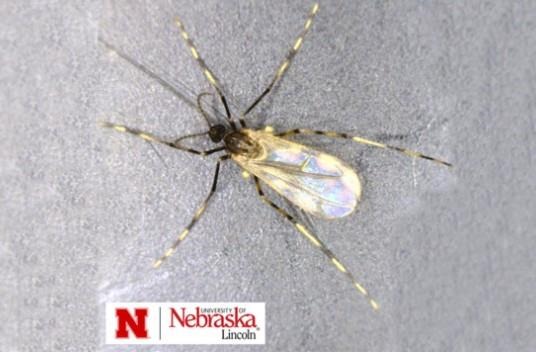
Soybean

We will continue to monitor our network of emergence cages. If you are interested in having emergence cages present in your field, please contact Adam Varenhorst, Assistant Professor and SDSU Extension Field Crop Entomologist .To get additional information on soybean gall midge, or to follow the emergence network updates, please visit the Soybean Gall Midge Alert Network website.

To receive notifications of first emergence reports, please follow the link below and provide the necessary information for the form. You will receive a phone call, text message, and email when adults are detected.

SIGN UP FOR UPDATES

Source : sdstate.edu

Trending Video

From Students to Solutions | On The Brink: Season 2, Episode 14

Video: From Students to Solutions | On The Brink: Season 2, Episode 14

Ask Canada’s most decorated soybean breeder his favourite part of the job and he doesn’t name a single variety. He names the students.

Istvan Rajcan is a professor of soybean breeding and genetics in the Department of Plant Agriculture at the University of Guelph, where he has run the soybean breeding program for 28 and a half years. In that time he has developed 87 soybean cultivars, published 140 refereed papers and trained 51 graduate students. In 2025 he received the Public Sector Impact Award from the National Association for Plant Breeding.

He is also worried. In this episode he says Canada is at a crossroads, pointing to recent government cuts to plant breeding programs and to the facilities that support them. His prescription is structural. "Plant breeding funding formula has to be a long-term one," he says.

The formula he is defending is the public-private matching arrangement his program runs on. Private seed companies fund the work, provincial or federal money matches it, and the combined pool stretches each dollar further than either source could alone. At the National Association for Plant Breeding annual meeting in June, he says American public breeders were often surprised at how well that collaboration works in Canada.

He also describes how the people entering plant breeding have changed. His early graduate students came mostly from farms. More recently they include, in his words, "city kids who just became excited about genetics."

Topics covered:

Why public-private plant breeding funding in Canada needs a long-term

commitment rather than a larger one

How matching private seed company investment with provincial and federal

dollars multiplies research capacity

How the graduate student pipeline into plant breeding has shifted from

farm kids to city kids